Content
For Religion it is more common to worship afterlife and destruction of life on Earth, than to support new ways of its appearance, like artificial insemination. For those, who can't have children, of course, only love for God remains. Priests are well aware about that and encourage infertile people to turn to the Lord (apparently, He inseminated a lot of couples). People, who talk about love, can gain power sooner and, after they have it, they can kill and justify their actions with excuses, that they are doing this out of love for you, Lord, and His work.
|
|
|
Adolf Hitler and the Order of the Jesuits
If you see a misrepresentation of facts or a mistranslation, please write to info@infidels.eu
 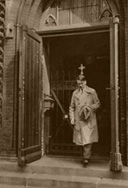
Believers like to lie that Adolf Hitler (1889–1945) was an atheist and that killing Jews has nothing to do with religion. In fact, he was a Roman Catholic. With his words and actions, Hitler made it clear to everyone more than once that he believed in God, carried out His will-mission and was even protected by God. This thought grew especially strong in him after the many unsuccessful attempts on his life.
“I am now as before a Catholic and will always remain so.”
Hitler said to General Gerhard Engel in 1941; John Toland [Pulitzer Prize winner], Adolf Hitler, New York: Anchor Books, 1992
Excerpts from the “atheist” Adolf Hitler’s personal book.
|
Adolf Hitler “My Struggle”
|
Adolf Hitler “Mein Kampf”
|
|
Volume 1 • A Reckoning
|
Band 1 • Eine Abrechnung
|
|
2. Years of Study and Suffering in Vienna: “Hence today I believe that I am acting in accordance with the will of the Almighty Creator: by defending myself against the Jew, I am fighting for the work of the Lord.”
|
2. Wiener Lehr und Leidensjahre: “So glaube ich heute im Sinne des allmächtigen Schöpfers zu handeln: Indem ich mich des Juden erwehre, kämpfe ich für das Werk des Herrn.”
|
|
6. War Propaganda: “Certainly we don’t have to discuss these matters with the Jews, the most modern inventors of this cultural perfume. Their whole existence is an embodied protest against the aesthetics of the Lord’s image.”
|
6. Kriegspropaganda: “Mit den Juden, als den modernen Erfindern dieses Kulturparfüms, braucht man sich aber darüber wahrhaftig nicht zu unterhalten. Ihr ganzes Dasein ist der fleischgewordene Protest gegen die Ästhetik des Ebenbildes des Herrn.”
|
|
8. The Beginning of My Political Activity: “What we must fight for is to safeguard the existence and reproduction of our race and our people, the sustenance of our children and the purity of our blood, the freedom and independence of the fatherland, so that our people may mature for the fulfillment of the mission allotted it by the creator of the universe.”
|
8. Beginn meiner politischen Tätigkeit: “Für was wir zu kämpfen haben, ist die Sicherung des Bestehens und der Vermehrung unserer Rasse und unseres Volkes, die Ernährung seiner Kinder und Reinhaltung des Blutes, die Freiheit und Unabhängigkeit des Vaterlandes, auf daß unser Volk zur Erfüllung der auch ihm vom Schöpfer des Universums zugewiesenen Mission heranzureifen vermag.”
|
|
Volume 2 • The National Socialist Movement
|
Band 2 • Die nationalsozialistische Bewegung
|
|
1. Philosophy and Party: “Whoever would dare to raise a profane hand against that highest image of God among His creatures would sin against the bountiful Creator of this marvel and would collaborate in the expulsion from Paradise.”
|
1. Weltanschauung und Partei: “Wer die Hand an das höchste Ebenbild des Herrn zu legen wagt, frevelt am gütigen Schöpfer dieses Wunders und hilft mit an der Vertreibung aus dem Paradies.”
|
|
10. Federalism as a Mask: “As far as regards that kind of ‘patriotic’ warrior, on behalf of the National Socialist Movement and therefore of the German people I pray with all my heart: ‘Lord, preserve us from such friends, and then we can easily deal with our enemies.’”
|
10. Der Föderalismus als Maske: “Ich kann, was diese Art von ‘völkischen’ Kämpfern betrifft, der nationalsozialistischen Bewegung und damit auch dem deutschen Volke aus aufrichtigstem Herzen nur wünschen: ‘Herr, bewahre sie vor solchen Freunden, auch sie wird mit ihren Feinden dann schon fertig werden.’”
|
|
13. German Alliance Policy after the War: “Almighty God, bless our arms when the hour comes. Be just, as Thou hast always been just. Judge now if we deserve our freedom. Lord, bless our struggle.”
|
13. Deutsche Bündnispolitik nach dem Kriege: “Allmächtiger Gott, segne dereinst unsere Waffen; sei so gerecht, wie du es immer warst; urteile jetzt, ob wir die Freiheit nun verdienen; Herr, segne unseren Kampf!”
|
|
14. Eastern Orientation or Eastern Policy: “And this action is the only one which, before God and our German posterity, would make any sacrifice of blood seem justified.”
|
14. Ostorientierung oder Ostpolitik: “Und diese Aktion ist die einzige, die vor Gott und unserer deutschen Nachwelt einen Bluteinsatz gerechtfertigt erscheinen läßt.”
|
Adolf Hitler didn’t believe in Evolution and was against mixing animals and races.
|
Volume 1, Chapter 11 • Race and People
|
Band 1, Kapitel 11 • Volk und Rasse
|
|
“Even a superficial glance is sufficient to show that all the innumerable forms in which the life-urge of Nature manifests itself are subject to a fundamental law – one may call it an iron law of Nature – which compels the various species to keep within the definite limits of their own life-forms when propagating and multiplying their kind.” (...) “This urge for the maintenance of the unmixed breed, which is a phenomenon that prevails throughout the whole of the natural world, results not only in the sharply defined outward distinction between one species and another but also in the internal similarity of characteristic qualities which are peculiar to each breed or species. The fox remains always a fox, the goose remains a goose, and the tiger will retain the character of a tiger. The only difference that can exist within the species must be in the various degrees of structural strength and active power, in the intelligence, efficiency, endurance, etc., with which the individual specimens are endowed.” (...) “In short, the results of miscegenation are always the following:
(a) The level of the superior race becomes lowered;
(b) physical and mental degeneration sets in, thus leading slowly but steadily towards a progressive drying up of the vital sap.
The act which brings about such a development is a sin against the will of the Eternal Creator. And as a sin this act will be avenged. Man’s effort to build up something that contradicts the iron logic of Nature brings him into conflict with those principles to which he himself exclusively owes his own existence. By acting against the laws of Nature he prepares the way that leads to his ruin.”
|
“Schon die oberflächliche Betrachtung zeigt als nahezu ehernes Grundgesetz all der unzähligen Ausdrucksformen des Lebenswillens der Natur ihre in sich begrenzte Form der Fortpflanzung und Vermehrung. Jedes Tier paart sich nur mit einem Genossen der gleichen Art.” (...) “Die Folge dieses in der Natur allgemein gültigen Triebes zur Rassenreinheit ist nicht nur die scharfe Abgrenzung der einzelnen Rassen nach außen, sondern auch ihre gleichmäßige Wesensart in sich selber. Der Fuchs ist immer ein Fuchs, die Gans eine Gans, der Tiger ein Tiger usw., und der Unterschied kann höchstens im verschiedenen Maße der Kraft, der Stärke, der Klugheit, Gewandtheit, Ausdauer usw. der einzelnen Exemplare liegen.” (...) “Das Ergebnis jeder Rassenkreuzung ist also, ganz kurz gesagt, immer folgendes:
a) Niedersenkung des Niveaus der höheren Rasse,
b) körperlicher und geistiger Rückgang und damit der Beginn eines, wenn auch langsam, so doch sicher fortschreitenden Siechtums.
Eine solche Entwicklung herbeiführen, heißt aber denn doch nichts anderes, als Sünde treiben wider den Willen des ewigen Schöpfers. Als Sünde aber wird diese Tat auch gelohnt. Indem der Mensch versucht, sich gegen die eiserne Logik der Natur aufzubäumen, gerät er in Kampf mit den Grundsätzen, denen auch er selber sein Dasein als Mensch allein verdankt. So muß sein Handeln gegen die Natur zu seinem eigenen Untergang führen.”
|
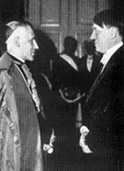
Adolf Hitler was a creationist and saw atheism as a danger.
|
Adolf Hitler said on 1941-10-14; Monologues in the Führer’s Headquarters; published by Orbis Verlag in 2000
“Educated man always stands in Reverence before Creation, which he can’t unriddle, but whose Greatness he feels; Uneducated man, on the other hand, is in Danger of jumping over to Atheism, that is, to Brutishness.”
|
Adolf Hitler sagte am 14. Oktober 1941; Monologe im Führerhauptquartier; Orbis Verlag, 2000
“Der gebildete Mensch steht immer in Ehrfurcht vor der Schöpfung, die er nicht enträtseln kann, deren Größe er aber empfindet; der Ungebildete hingegen ist in Gefahr, zum Atheismus, das ist zum Vertiert sein, überzuspringen.”
|
“We don’t want to educate anyone in atheism.”
Adolf Hitler; Table-Talk, p. 6; Monologe, 1941-07-11/12
 “Secular schools can never be tolerated because such schools have no religious instruction, and a general moral instruction without a religious foundation is built on air; consequently, all character training and religion must be derived from faith... We need believing people.”
Adolf Hitler (The German Churches Under Hitler, p. 241)
Hitler applied religious principles in politics.
“I learned much from the Order of the Jesuits… until now there has never been anything more grandiose on the earth than the hierarchical organization of the Catholic Church. I transferred much of this organization into my own party.”
Hitler to Hermann Rauschning, as Rauschning claims in Hitler m’a dit (1939), pp. 266–267
Hitler saw Jesus as a fighter against the Jews and blamed the Jews for His death.
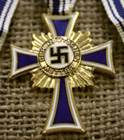 “My feeling as a Christian points me to my Lord and Saviour as a fighter. It points me to the man who once in loneliness, surrounded only by a few followers, recognized these Jews for what they were and summoned men to the fight against them and who, God’s truth! was greatest not as sufferer but as fighter. In boundless love as a Christian and as a man I read through the passage which tells us how the Lord at last rose in His might and seized the scourge to drive out of the Temple the brood of vipers and of adders. How terrific was His fight for the world against the Jewish poison to-day, after two thousand years, with deepest emotion I recognize more profoundly than ever before in the fact that it was for this that He had to shed His blood upon the Cross. As a Christian I have no duty to allow myself to be cheated, but I have the duty to be a fighter for truth and justice... And if there is anything which could demonstrate that we are acting rightly it is the distress which daily grows. For as a Christian I have also a duty to my own people.”
Adolf Hitler, in a speech on 1922-04-12 (Norman H. Baynes, ed. The Speeches of Adolf Hitler, April 1922–August 1939, Vol. 1 of 2, pp. 19–20, Oxford University Press, 1942)
Hitler saw himself as a reformer of Christianity, not as a fighter against it.
Hitler never renounced Christ and his Christianity. He fought against Christians who, as he thought, corrupted Christianity. Hitler saw himself as Jesus and Martin Luther:
“Luther had the merit of rising against the Pope and the organisation of the Church. It was the first of the great revolutions. And thanks to his translation of the Bible, Luther replaced our dialects by the great German language!”
Hitler; Table-Talk, p. 9; Monologe, night of 1941-07-21/22
“The decisive falsification of Jesus’s doctrine was the work of St. Paul. He gave himself to this work with subtlety and for purposes of personal exploitation. For the Galilean’s object was to liberate His country from Jewish oppression. He set Himself against Jewish capitalism, and that’s why the Jews liquidated Him.”
Hitler; Table-Talk, p. 76; Monologe, 1941-10-21
“Christ was an Aryan, and St. Paul used his doctrine to mobilise the criminal underworld and thus organise a proto-Bolshevism.”
Hitler; Table-Talk, p. 143; Monologe, 1941-12-13
 The mere fact that Hitler tried to create his own version of Christianity and prove that Jesus was not a Jew, and therefore argued with other Christians, does not make him an unbeliever or anti-Christian. Christians constantly fight each other over “true” Christianity, even till blood, and accuse their opponents of not being “true” Christians. Hitler didn’t reject Christianity. He just criticised its organised version and admired the more militant “Order of Jesuits” as a model, because he thought that the other branches were corrupted and too weak to defend Christian ideals and beliefs.
If Protestants fight against the Catholic version of Christianity, that doesn’t mean that Protestants are not Christians and don’t belong to Christianity. Believers often have their own personalised understanding of religion and God and fight against other or organised religions. Sometimes even against their own organised religion, thinking, for example, that it is corrupted, perverted and greedy, that organised religion is not needed, because God must be a private thing, etc.
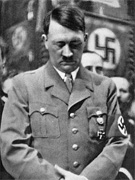 There is no single standard of Christianity. Each group declares itself the “standard”, although all groups, like individuals, are different and have their own personal, self-tailored modifications of God and His worship. These differences-modifications arise from different, subjective life experience and knowledge and from a wish to satisfy personal needs at the lowest cost and to get into Heaven as easily as possible. Therefore, for you, Mormons or the Pope “true” Christianity is ONE thing, and for Hitler, Mother Teresa, the Orthodox or some guy in India it will be something completely OTHER. Christians will constantly fight each other over “true” Christianity, because people’s personal needs often clash and nobody wants to see himself as a loser or fallible. That does not make the fighters non-Christians. People want to take more than to give. Hitler modified Christianity to make it more profitable for himself (all Christians do it, they are just reluctant to admit it to themselves) and honestly believed that these modifications led to “true” Christianity. Those who profited from Hitler’s modifications honestly acknowledged the changes as leading TO “true” Christianity. Those who suffered losses claimed that the changes led away FROM “true” Christianity. As a Christian, Hitler brought shame on Christianity, and today’s Christians get no benefit from his ideas, which put them in an uncomfortable position. That is why today’s Christians do not support Hitler’s changes, considering them a deviation from “true” Christianity. They reject Hitler’s view of himself as a “true” Christian, because he does not fit their subjective idea of what a “true” Christian is. The Christian tactic is to create an imaginary etalon of the ideal Christian, and then any person who puts “brothers in faith” in an uncomfortable position can be called a “not true” Christian. This way they can wash their hands and avoid responsibility for the deeds of the organisation’s members.
Hitler believed in the Christian God, in Christ; he went to a Christian church and prayed. He had all the basics of Christianity. He was the same sweet of sh*, just in a different wrapping. As for killing – there is another True Christian besides Hitler: God, who lied, cheated, killed, robbed and was a paedophile. So everyone who commits the same sins can consider himself a true Christian... unless God is an “Atheist” too.
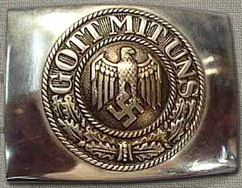 The “atheist” Hitler’s “atheistic” army wore inscriptions displaying their “atheism” on their military uniforms, such as belt buckles reading “God With Us” (“Gott mit uns”). Some ideas on how to exterminate and persecute Jews, Hitler copied from earlier Popes. For example, making Jews wear special signs was not Hitler’s idea, but Pope Innocent III’s (Fourth Lateran Council, 1215). Pope Paul IV ordered them herded into ghettos in the 1555 bull “Cum nimis absurdum”. It is no secret that even the late Pope Joseph Alois Ratzinger was a member of the “Hitler Youth” (“Hitler-Jugend”) (of course, he was only a teenager then :). Fascism, with Mussolini, was born and flourished nowhere else but in Italy... those who know geography can easily tell where the Vatican is.
Some English quotes against Christianity by Adolf Hitler can be fabricated.
Sources of whatever Hitler said in his bunker in East Prussia:
(HH) Heim’s notes: 1941, 1942
(HP) Picker’s notes: 1942
├── (MB) Bormann’s collection: Heim’s and Picker’s originals → ... → sold to Genoud
│   ├── (FG) Genoud’s French: 1952, 1954
│   │   └── (SC) Stevens’ and Cameron’s English, mainly from Genoud’s (FG): 1953, 1973, 2000
│   └── (WJ) Jochmann’s German from Genoud’s (MB), without Picker’s notes: 1980
└── (HH, HP) Picker’s German (Picker’s notes + 36 Heim notes): 1951, 1963, 1976
(HH, HP) 1951, 1963, 1976 German version: Henry Picker “Hitlers Tischgespräche im Führerhauptquartier” (“Hitler’s Table Talk in the Führer’s Headquarters”). These are the notes of Bormann’s aides Heinrich Heim and Henry Picker. This edition ranks first in authenticity. It contains the original German. It was published first and is confirmed by eyewitness testimony. It also has scholarly backing on the title page: “Arranged on behalf of the German Institute for the History of National Socialism, introduced and published by Gerhard Ritter, professor of history at the University of Freiburg”. Another historian, Walter Mediger, checked the first edition (1951) against the original notes and corrected it in the second edition (1963).
(FG) 1952 French version: François Genoud “Libres Propos sur la Guerre et la Paix: Recueillis sur l’Ordre de Martin Bormann” (“Candid Remarks on the War and the Peace: Collected by Order of Martin Bormann”). It is the “Bormann-Vermerke” (“Bormann Notes”), compiled by Hitler’s right-hand man Martin Bormann, without Henry Picker’s notes.
(SC) 1953, 1973 and 2000 English version: R. H. Stevens, Norman Cameron “Hitler’s Table Talk, 1941–1944”, “Hitler’s Secret Conversations, 1941–1944”. Edited by Hugh Trevor-Roper. “Officially” translated from (MB), but in fact mainly from François Genoud’s (FG).
(WJ) 1980 German version: Werner Jochmann “Monologe im Führerhauptquartier 1941–1944: die Aufzeichnungen Heinrich Heims herausgegeben von Werner Jochmann” (“Monologues in the Führer’s Headquarters: the Notes of Heinrich Heim edited by Werner Jochmann”). It publishes the German Bormann collection (MB), used by François Genoud.
Christians quote Hitler’s “anti-religious” remarks from the English (SC) version, whose source was the French (FG) version. The German (HH, HP) and (WJ) versions do not have these words. The French version and its English translation sharpen and generalise Hitler’s attacks on the Church and its teachings, as the examples given below show.
|
German version
|
English translation from French
|
|
1942-02-27, midday – (HH, HP) 1976, No. 29, p. 115; (WJ) No. 148, p. 303:
“The time in which we live has the appearance of the collapse of this idea [German: “dieser Sache” – this thing]. It can still take 100 or 200 years. I am sorry that, like Moses, I can only see the Promised Land from a distance.”
(HH, HP): “Die Zeit, in der wir leben, ist die Erscheinung des Zusammenbruchs dieser Sache. Es kann 100 oder 200 Jahre noch dauern. Es tut mir leid, dass ich wie Moses das Gelobte Land nur aus der Ferne sehen kann.”
|
(SC) 2000, No. 163, p. 343:
“Our epoch will certainly see the end of the disease of Christianity. It will last another hundred years, two hundred years perhaps. My regret will have been that I couldn’t, like whoever the prophet was, behold the promised land from afar.”
(FG) 1952, p. 332: “Notre époque verra sans doute la fin de la maladie chrétienne. C’est une affaire de cent ans, de deux cents ans peut-être. Mon regret aura été, à l’instar de tel prophète, de n’apercevoir que de loin la terre promise.”
|
|
1942-02-27, midday – (HH, HP) 1976, No. 29, p. 115; (WJ) No. 148:
“One should never personally fall in line with such a lie.”
(HH, HP): “Man darf sich persönlich einer solchen Lüge niemals fügen.”
(WJ): “Ich persönlich werde mich einer solchen Lüge niemals fügen…”
|
(SC) 2000, No. 163, p. 343:
“I shall never come personally to terms with the Christian lie.”
(FG) 1952, p. 332: “Je ne m’accommoderai personnellement jamais du mensonge chrétien.”
|
|
1941-12-13, midday – (HH, HP) 1976, No. 11, p. 81:
“Christianity teaches ‘transubstantiation’, which is the maddest thing ever concocted by a human mind in its delusions, a mockery of all that is godly.”
(HH, HP): “Das Christentum lehrt die ‘Wandlung’, das ist das Tollste, was je ein Menschengehirn in seinem Wahn hervorgebracht hat, eine Verhöhnung von allem Göttlichen.”
(WJ) No. 65, p. 150: “Das Christentum ist das Tollste, das je ein Menschengehirn in seinem Wahn hervorgebracht hat, eine Verhöhnung von allem Göttlichen.”
|
(SC) 2000, No. 75, p. 144:
“But Christianity is an invention of sick brains: one could imagine nothing more senseless, nor any more indecent way of turning the idea of the Godhead into a mockery.”
(FG) 1952, p. 141: “Mais le christianisme est une invention de cerveaux malades : on ne saurait rien imaginer de plus insensé, ni une façon plus inconvenante de tourner en dérision l’idée de la divinité.”
|
François Genoud “Hitler’s Last Testament” and David Irving.
François Genoud’s documents “Le Testament Politique de Hitler” (French, 1959) and “The Testament of Adolf Hitler: The Hitler–Bormann Documents” (English, 1961, with an introduction by Professor Hugh Trevor-Roper) can also be fake.
Read more about how François Genoud falsified Hitler’s testament and words, and Trevor-Roper kept quiet about it... here.
“Hitler’s Last Testament” (“Hitlers politisches Testament”) by François Genoud should not be confused with the real last will and testament of Adolf Hitler, dictated by Hitler to his secretary Traudl Junge and signed by Goebbels, Burgdorf, Bormann and Krebs. These are two different documents.
 Note: David Irving (fpp.co.uk) became known as a “Holocaust denier”, though he himself claims that he DOES NOT deny the Holocaust or that Germans murdered people. He says (Ireland, RTÉ One, The Late Late Show, presented by Pat Kenny, 2008-03-07, 2:15–2:55) that he is not so stupid as to deny the Holocaust, as the media portrays him. He argues about the details of the killing, about how much Hitler knew about it and about the numbers, claiming that the Nazis killed not 6 million but up to 3 million Jews. David Irving admits that Hitler, as head of state, is fully responsible for the killings. Irving believes that the value of human life does not depend on race; therefore he would like to replace the crime’s names “Holocaust” and “genocide” (killing of people of a race) with the word “innocenticide” (killing of innocent people), so that Jews would no longer be the exclusive victims of World War 2.
Leaps in the numbers and why “6 million − Auschwitz’s 3 million = 6 million”.
At the 1945–1946 Nuremberg Trials it was claimed that about 3 million people died in the Auschwitz concentration camp.
In 1967–1990 the Auschwitz State Museum stated 4 million, but after historical research the number was lowered to 1.1 million.
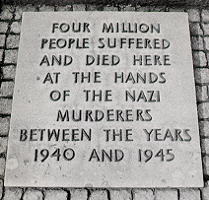 |
Auschwitz State Museum’s Memorial Plaque (1967–1990) claimed 4 million deaths. |
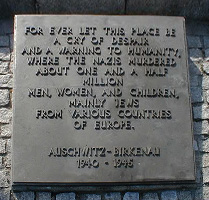 |
Auschwitz State Museum’s Memorial Plaque from 1995 claimed 1.5 million deaths. |
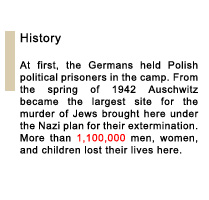 |
Auschwitz State Museum’s web site today (2012-02-05) claims 1.1 million deaths. |
The 6 million figure was never based on the false 1967–1990 Auschwitz memorial plaque. In 1944, Adolf Eichmann (SS, Gestapo) told Wilhelm Höttl (SS) that about 4 million Jews had died in the camps and 2 million in other ways, mostly shot (Höttl’s affidavit at the Nuremberg Trials). Historians later counted fewer victims in the camps, but more shot and dead in the ghettos, so the total remained at about 6 million.
| Jews killed |
Eichmann
(1944) |
Hilberg
(1985) |
USHMM
(today) |
| Auschwitz |
|
1,000,000 |
1,000,000 |
| Treblinka |
|
750,000 |
925,000 |
| Bełżec |
|
550,000 |
435,000 |
| Sobibór |
|
200,000 |
167,000 |
| Chełmno |
|
150,000 |
152,000 |
| Majdanek and other camps |
|
350,000 |
|
| All camps |
4,000,000 |
3,000,000 |
2,700,000 |
| Shot |
2,000,000 |
1,300,000 |
2,000,000 |
| Ghettos and other camps |
800,000 |
800,000–1,000,000 |
| Other killings |
|
250,000 |
| Total |
6,000,000 |
5,100,000 |
6,000,000 |
Rounded figures. Sources: Höttl’s affidavit (Nuremberg, 1945); Raul Hilberg, The Destruction of the European Jews (1985), table B-1; United States Holocaust Memorial Museum.
Justice
4 million or 1.1 million… either way it is a big crime against humanity. Numbers may not matter to accusers, but criminals must be punished only for what they did. If someone killed 1 person, it is not acceptable to claim that he killed 4, no matter how much we hate the criminal. Are the administration of the Auschwitz State Museum, who lowered the numbers, “Holocaust deniers”? NO. After a detailed investigation they refined the number so that it would fit the historical facts and documents better than the earlier claims. Inflating the numbers, like minimising them, is a historical crime. History must be presented as precisely as possible, and the judge should not lie like the criminal.
Infidels
Comments • 0
|
|
|
Joseph Stalin and the Orthodox Christian Church of Russia
The majority of sources about Stalin were gathered from Russia, which is not known as a beacon of truth.
If you see a misrepresentation of facts or a mistranslation, please write to info@infidels.eu
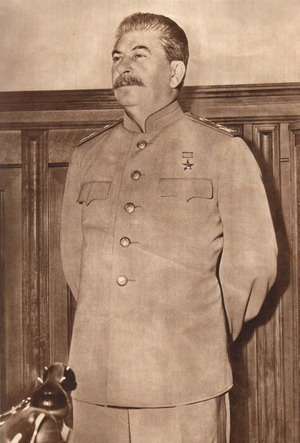
It is a usual thing for religious people and societies to call Joseph Stalin an “atheist”, as they have done many times with Adolf Hitler. Of course, there is no doubt that the majority of Soviet leaders, including Vladimir Lenin, Nikita Khrushchev and Mikhail Gorbachev, were atheists and a few of them even militant. However, the bloodiest communist regime dictator, Joseph Stalin (1878–1953), was not simply an ATHEIST, but a RELIGIOUS COMMUNIST. As a boy he was a believer. There was a period in his life (during and after the humiliating and cruel regime in the Tbilisi Priest Seminary and the revolution time, when Stalin fought against the monarchical dictatorship supported by the church) when he held a grudge against priests and religion, struggled and leaned more towards atheism. But during the war he returned to his religious roots and chose to resurrect and protect religion in the USSR. Whether he believed again or only used religion for power is hard to tell now: in the secular Soviet Union he could not believe openly. Stalin used blind faith-based religious principles to strengthen his own dictatorship. Stalin was born in 1878. He received more power and started his mass-murder journey through corpses in 1922 and died in 1953.
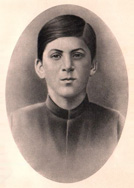
~6 years in Church School and ~5 years in Priest Seminary.
Stalin grew up in a religious family, and it was planned that he would become a priest. Therefore Stalin received religious education in Gori Church School (1888-09-01 – 1894-06-??) and Tbilisi Priest Seminary (1894-09-01 – 1899-05-29), which he didn’t finish, because he joined the Revolution movement. Ideas about rich people as oppressors of the poor, how to defend poor people from them and that rich people will go to Hell or, at least, it will be hard for them to go to (communistic) heaven, Stalin collected from his religious education and the Bible.
Bible:NT:Matthew:19:23–24 And Jesus said to his disciples, “Truly, I say to you, it will be hard for a rich man to enter the kingdom of heaven. Again I tell you, it is easier for a camel to go through the eye of a needle than for a rich man to enter the kingdom of God.”
Bible:NT:James:2:5–6 “Listen, my beloved brethren. Has not God chosen those who are poor in the world to be rich in faith and heirs of the kingdom which he has promised to those who love him? But you have dishonored the poor man. Is it not the rich who oppress you, is it not they who drag you into court?”
Bible:NT:James:5:1 “Come now, you rich, weep and howl for the miseries that are coming upon you.”
The Bible explains that if you want to be a real believer, you must resign your possessions and give them to the poor.
Bible:NT:Luke:12:33 “Sell your possessions, and give alms; provide yourselves with purses that do not grow old, with a treasure in the heavens that does not fail, where no thief approaches and no moth destroys.”
Bible:NT:Mark:10:21–22 And Jesus looking upon him loved him, and said to him, “You lack one thing; go, sell what you have, and give to the poor, and you will have treasure in heaven; and come, follow me.” At that saying his countenance fell, and he went away sorrowful; for he had great possessions.
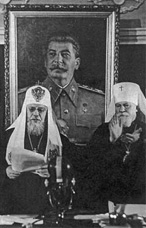
Latin communis = English collective, shared. Sometimes people think that communism (collective, shared property, no private property) was an atheistic idea and that “communist = atheist”. But communism was promoted in the Bible as a model of the ideal society for believers. Christ’s followers in the Bible lived as true communists by having common property, as in the “ideal society” dreamed of by the USSR communists.
Bible:NT:Acts:2:44–45 And all who believed were together and had all things in common; and they sold their possessions and goods and distributed them to all, as any had need.
Bible:NT:Acts:4:32–35 Now the company of those who believed were of one heart and soul, and no one said that any of the things which he possessed was his own, but they had everything in common. And with great power the apostles gave their testimony to the resurrection of the Lord Jesus, and great grace was upon them all. There was not a needy person among them, for as many as were possessors of lands or houses sold them, and brought the proceeds of what was sold and laid it at the apostles’ feet; and distribution was made to each as any had need.
Yes, communism was not invented by Lenin and Marx.
Those who hide and don’t share all their possessions must die (“Stalinism”).
Bible:NT:Acts:4:36–37 Thus Joseph who was surnamed by the apostles Barnabas (which means, Son of encouragement), a Levite, a native of Cyprus, sold a field which belonged to him, and brought the money and laid it at the apostles’ feet.
Bible:NT:Acts:5:1–10 (Ananias and Sapphira) But a man named Anani′as with his wife Sapphi′ra sold a piece of property, and with his wife’s knowledge he kept back some of the proceeds, and brought only a part and laid it at the apostles’ feet. But Peter said, “Anani′as, why has Satan filled your heart to lie to the Holy Spirit and to keep back part of the proceeds of the land? While it remained unsold, did it not remain your own? And after it was sold, was it not at your disposal? How is it that you have contrived this deed in your heart? You have not lied to men but to God.” When Anani′as heard these words, he fell down and died. And great fear came upon all who heard of it. (...) After an interval of about three hours his wife came in, not knowing what had happened. And Peter said to her, “Tell me whether you sold the land for so much.” And she said, “Yes, for so much.” But Peter said to her, “How is it that you have agreed together to tempt the Spirit of the Lord? Hark, the feet of those that have buried your husband are at the door, and they will carry you out.” Immediately she fell down at his feet and died. (...)
Believers also forget how property was and still is managed in the Church and monasteries, where there is no private property. Monks, nuns and many Christian priests live by sharing property, avoiding private possessions and being rich, as pure communists. And they promote such a way of life – pure communism in all its glory. Are they atheists? The Church and monasteries adopted and realised the “atheistic” ideas of common-shared property almost two thousand years before the revolution in Russia (1917) even started.
Believers throw accusations easily. Without any shame, they call “atheists” those believers who did bad things or were communists – of course, doing bad is not “compatible” with Christianity :).
Stalin wrote poems which were published by local newspapers.
|
* * *
In this world he, like a phantom,
wandered from door to door;
in his hands he held an oak panduri
and made its voice ring sweetly.
In his dreamy melodies,
like a ray of the Sun,
the truth itself was heard
and heavenly love.
That voice made many a heart beat,
a heart that had turned to stone;
it lit up many a mind
that had turned into pitch darkness.
But, instead of glory,
where his harp rang out,
there the crowd set before the outcast
a bowl filled with poison...
And they told him: “Drink it up, cursed one,
that is your lot!
We don’t want your truth,
nor those heavenly sounds of yours!”
Iveria, 1895, № 280, p. 1
|
* * *
ამ ქვეყნად იგი, ვით ლანდი,
კარის-კარ დაწრიალებდა;
ხელთ ეპყრა მუხის ფანდური,
ხმა-ტკბილად აწკრიალებდა;
მის საოცნებო ჰანგებში,
ვითარცა სხივი მზიური,
ისმოდა თვითონ სიმართლე
და სიყვარული ციური.
ბევრს აუძგერა იმა ხმამ
გული, ქვად გადაქცეული;
ბევრს გაუნათლა გონება,
ბნელ-უკუნეთად ქცეული.
მაგრამ დიდების მაგიერ,
სად ჩანგმა გაიწკრიალა,
განდევნილს ბრბომ იქ დაუდგა
შხამით აღსავსე ფიალა...
და უთხრეს: „შესვი, წყეულო,
ეგ არის შენი ხვედრიო!
შენი არ გვინდა სიმართლე,
არც ეგ ციური ხმებიო!“...
ივერია, 1895, № 280, გვ. 1
|
|
Igor Kurliandsky: “Let us pay attention to the quatrain ‘To Kolya Kavsadze’, composed by the young Stalin in Gori, in which a motif of church intercession, unique for Joseph, can be heard.”
|
Игорь Курляндский: "Обратим внимание на сочиненное в Гори четверостишие юного Сталина «Коле Кавсадзе», в котором прозвучал уникальный для Иосифа мотив церковного заступничества."
|
Stalin’s wedding.
With the help of Michael Tskhakaya (Михаил Григорьевич Цхакая) from the Priest Seminary as the godfather at the wedding, Stalin and his first wife Ekaterina Svanidze (Екатерина Семёновна Сванидзе) married secretly in Tiflis’s Church of St. David in 1906.
The documentary “Stalin. Part Two. Personal life in the revolution”, directed by Elena Tikhonova, 2003. (Документальный фильм «Сталин. Часть вторая. Личная жизнь в революции», режиссер Елена Тихонова, 2003.)
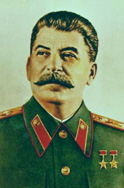
Stalin told his daughter Svetlana Alliluyeva-Stalin that Christ existed.
|
“Mysteries of the Century: Kremlin Kids”
2003-03-19, Channel One Russia
|
«Тайны века: Дети Кремля»
2003-03-19, Первый канал, Россия
|
|
Presenter: It is interesting that of all the residents of the Kremlin, probably only Stalin believed in God...
|
Ведущий: Интересно, что из обитателей Кремля, наверное, только Сталин верил в Бога...
|
|
S.Alliluyeva: In my father’s library, among other books, were a few tomes of “Christ”. It was a history of Christ written by the Narodnaya Volya member Morozov. I said to my father: “But Christ didn’t exist!” and he answered: “Oh no, Christ, certainly, existed.” (author’s note: Stalin’s answer may be about history rather than faith)
|
С.Аллилуева: У отца среди книг в библиотеке стояли несколько томов «Христос». Это история Христа, написанная народовольцем Морозовым. Я сказала отцу: «Но ведь Христос не существовал!». А он ответил «Да нет, Христос, конечно, существовал».
|
In another, bigger interview with the Russian magazine “Version” («Версия») and the second Russian TV channel RTR (РТР) (1998) Svetlana spoke more about her father’s belief in God. She said that Stalin later told her the history of Christ. And she thinks that he was a believer. Stalin’s wife Nadezhda (Надежда Сергеевна Аллилуева) was most likely an atheist, because she forbade the nannies to talk about God with the kids. But it was not a big problem – (maybe, with God’s help :) Nadezhda shot herself in 1932. It is symbolic that her name Надежда means “Hope”. Stalin’s daughter said that after her mother’s death Stalin lost everything human in him.
Stalin prohibits the liquidation of churches and the persecution of believers.
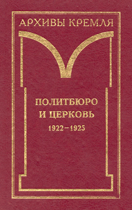
1997. АРХИВЫ КРЕМЛЯ. В 2-Х КН. / КН. 1. ПОЛИТБЮРО И ЦЕРКОВЬ.1922-1925 ГГ. ISBN 5-86004-113-6
1998. АРХИВЫ КРЕМЛЯ. В 2-Х КН. / КН. 2. ПОЛИТБЮРО И ЦЕРКОВЬ.1922-1925 ГГ. ISBN 5-8243-0001-1
www.orthomed.ru/ftproot/abort_mr/books/history/library/archvs4.htm
|
ARCHIVES OF THE KREMLIN
|
АРХИВЫ КРЕМЛЯ
|
|
POLITICAL BUREAU AND CHURCH
1922–1925
|
ПОЛИТБЮРО И ЦЕРКОВЬ
1922-1925 гг.
|
|
File №12. “Antireligious work”
|
Дело №12. "Антирелигиозная работа"
|
|
№12-56:
|
№ 12-56:
|
|
The circular letter of the CC RKP(b) №30 “about the attitude to religious organisations”, 1923-08-16
|
Циркулярное письмо ЦК РКП(б) № 30 "об отношении к религиозным организациям" 16 августа 1923 г.
|
|
Strictly – Confidential
|
Строго – Секретно
|
|
TO ALL PROVINCIAL, REGIONAL and TERRITORIAL COMMITTEES, NATIONAL CCs and CC BUREAUS. The CIRCULAR LETTER of the CC RKP №30 (About the attitude to religious organisations).
|
ВСЕМ ГУБКОМАМ, ОБКОМАМ, КРАЕВЫМ КОМИТЕТАМ, НАЦИОНАЛЬНЫМ ЦК и БЮРО ЦК. ЦИРКУЛЯРНОЕ ПИСЬМО ЦК РКП №30 (Об отношении к религиозным организациям).
|
|
The Central Committee recommends that all organisations of the party pay the most serious attention to a number of serious violations committed by some organisations in the field of anti-religious propaganda and, in general, in the field of attitudes to believers and to their cults.
|
ЦК предлагает всем организациям партии обратить самое серьезное внимание на ряд серьезных нарушений, допущенных некоторыми организациями в области антирелигиозной пропаганды и, вообще, в области отношений к верующим и к их культам.
|
|
The party programme says: “it is necessary to carefully avoid any insult to the feelings of believers, which leads only to the strengthening of religious fanaticism”. The resolution of the 12th Party Congress, concerning anti-religious agitation and propaganda, confirms that “deliberately rough actions, often practised in the centre and locally, mockery of subjects of belief and cult, instead of serious analysis and explanation – do not accelerate, but complicate the liberation of workers from religious superstitions.”
|
Партийная программа говорит: “необходимо заботливо избегать всякого оскорбления чувств верующих, ведущего лишь к закреплению религиозного фанатизма”. Резолюция ХII-го Партсъезда по вопросам антирелигиозной агитации и пропаганды подтверждает, что “нарочито грубые приемы, часто практикующиеся в центре и на местах, издевательство над предметами веры и культа, взамен серьезного анализа и объяснения – не ускоряют, а затрудняют освобождение трудящихся масс от религиозных предрассудков”.
|
|
Meanwhile, some of our local organisations systematically break these clear and definite instructions of the party programme and the party congress.
|
Между тем некоторые из наших местных организаций систематически нарушают эти ясные и определенные директивы партийной программы и партийного съезда.
|
|
The Irkutsk Provincial Executive Committee, with one stroke of the pen, ended from June 26th of this year the existence of all Baptist societies in the whole province and also closed their prayer houses for “political reasons”. The Oryol Provincial Executive Committee closed churches and prayer premises in the whole province for not following administrative orders, for non-registration, not even taking into account that the registration deadline had been postponed. In the Kliuchinsk glass factory of Tver province and in the factory “Communistic vanguard” (former Sobinka) of Vladimir province, decisions on closing churches and prayer premises were made by voting at general meetings, and these decisions served as a basis for the local authorities to close churches, and in the latter cases the matter reached an armed conflict of believing workers with communists and young communists. The Mtsensk Executive Committee (Oryol province) declared in a rude form to representatives of church councils the taxation of each church from 100 to 500 roubles in gold as a penalty for not registering, and the request to justify such collecting was followed by a threat of arrest, and after this an arrest followed. All over Transcaucasia, especially in Georgia, tens of churches are being closed absolutely illegally, in violation of the instructions of the party, causing anxiety and dissatisfaction among the population. In Minsk (Belarus), in Kharkov (Ukraine), Poltava (Ukraine), Kremenchug (Ukraine), Loyev (district Rechitsky, Gomel pr.), Birzula (Odessa pr. Ukraine), Simferopol (Crimea) and in many other cities of the south and south-west of the USSR, the local Jewish prayer houses were closed by the local authorities. Etc., etc.
|
Иркутский Губисполком одним расчерком пера прекратил с 26. VI с. г. существование всех баптистских обществ по всей губернии и закрыл их молитвенные дома по “политическим соображениям”. Орловский губисполком закрыл по всей губернии церкви и молитвенные помещения за неисполнение административных распоряжений, за нерегистрацию, несмотря даже на то, что срок регистрации был отсрочен. На Ключинском стекольном заводе Тверской губернии и на фабрике “Коммунистический авангард” (б. Собинка) Владимирской губерний голосованием на общих собраниях вынесены решения о закрытии церквей, молитвенных помещений и эти решения послужили основанием для местной власти к закрытию церквей, причем в последних случаях дело дошло до вооруженного столкновения верующих рабочих с коммунистами и комсомольцами. Мценский уисполком (Орловской губернии) объявил в грубой форме представителям церковных советов об обложении каждой церкви от 100 до 500 рубл. золотом, как штраф за нерегистрацию, причем на просьбу о предъявлении основания взыскания последовала угроза арестом, а вслед за этим и арест. По всему Закавказью, особенно в Грузии, закрываются десятки церквей совершенно незаконно, с нарушением директив партии, вызывая среди населения брожение, недовольство. В Минске (Белоруссия), в Харькове (Украина), Полтаве (Украина), Кременчуге (Украина), Лоеве (Речицкий уезд, Гомельской губ.), Бирзуле (Одесская губ. Украина), Симферополе (Крым) и во многих других городах юга и юго-запада СССР были местной властью закрыты еврейские молитвенные дома. И т. д., и т. д.
|
|
These and numerous similar examples show with sufficient vividness how carelessly, unseriously and frivolously some local organisations of the Party and local authorities treat such an important question as the question of freedom of religious beliefs. These organisations and authorities, probably, do not understand that by rough, tactless actions against the believers, who represent the enormous majority of the population, they do incalculable harm to the Soviet authority, threaten to wreck the achievements of the party in the field of the decomposition of the church and risk helping the counter-revolution.
|
Эти и подобные им многочисленные примеры с достаточной яркостью свидетельствуют о том, как неосторожно, не серьезно, легкомысленно относятся некоторые местные организации Партии и местные органы власти к такому важному вопросу, как вопрос о свободе религиозных убеждений. Эти организации и органы власти, видимо, не понимают, что своими грубыми, безтактными действиями против верующих, представляющих громадное большинство населения, они наносят неисчислимый вред советской власти, грозят сорвать достижения партии в области разложения церкви и рискуют сыграть на руку контрреволюции.
|
|
Proceeding from what has been said, the CC decides:
|
Исходя из сказанного, ЦК постановляет:
|
|
1. To prohibit the closing of churches, prayer premises and synagogues on the grounds of not carrying out administrative orders about registration, and where such closing has taken place – to repeal it immediately;
|
1. воспретить закрытие церквей, молитвенных помещений и синагог по мотивам неисполнения административных распоряжений о регистрации, а где таковое закрытие имело место – отменить немедля;
|
|
2. To prohibit the liquidation of prayer premises, buildings and so forth by voting at assemblies with the participation of non-believers or outsiders to the group of believers that concluded the contract for the premises or building;
|
2. воспретить ликвидацию молитвенных помещений, зданий и проч. путем голосования на собраниях с участием неверующих или посторонних той группе верующих, которая заключила договор на помещение или здание;
|
|
3. To prohibit the liquidation of prayer premises, buildings and so forth for not paying taxes, insofar as such liquidation is allowed not in strict accordance with the 1918 instruction of the People’s Commissariat of Justice, item 11;
|
3. воспретить ликвидацию молитвенных помещений, зданий и пр. за невзнос налогов, поскольку такая ликвидация допущена не в строгом соответствии с инструкцией НКЮ 1918 г. п. 11;
|
|
4. To prohibit arrests of a “religious character”, insofar as they are not connected with obviously counter-revolutionary acts of “priests” and believers;
|
4. воспретить аресты "религиозного характера", поскольку они не связаны с явно контр-революционными деяниями "служителей церкви" и верующих;
|
|
5. When leasing premises to religious societies and defining rates, to follow strictly the decision of the All-Russian Central Executive Committee of 1923-03-29;
|
5. при сдаче помещений религиозным обществам и определении ставок строжайше соблюдать постановление ВЦИК-а от 29/III-23 г.;
|
|
6. To explain to members of the party that our success in the cause of the decomposition of the church and the eradication of religious superstitions depends not on persecutions of believers – persecutions only strengthen religious prejudices – but on a tactful attitude to believers, on patient and thoughtful criticism of religious superstitions, on serious historical illumination of the idea of god, cult and religion and so forth;
|
6. разъяснить членам партии, что наш успех в деле разложения церкви и искоренения религиозных предрассудков зависит не от гонений на верующих – гонения только укрепляют религиозные предрассудки, – а от тактичного отношения к верующим при терпеливой и вдумчивой критике религиозных предрассудков, при серьезном историческом освещении идеи бога, культа и религии и пр.;
|
|
7. To assign the responsibility for putting this instruction into practice to the secretaries of provincial committees, regional committees, regional bureaus, national Central Committees and territorial committees personally.
|
7. ответственность за проведение в жизнь данной директивы возложить на секретарей губкомов, обкомов, облбюро, национальных ЦК и крайкомов лично.
|
|
At the same time, the Central Committee warns that such an attitude to the church and believers should not, however, in any measure weaken the vigilance of our organisations in the sense of careful supervision to ensure that the church and religious societies do not turn religion into an instrument of counter-revolution.
|
ЦК вместе с тем предостерегает, что такое отношение к церкви и верующим не должно, однако, ни в какой мере ослабить бдительность наших организаций в смысле тщательного наблюдения за тем, чтобы церковь и религиозные общества не обратили религию в орудие контр-революции.
|
|
CC Secretary I.Stalin. 1923-08-16
|
Секретарь ЦК И. Сталин. 16/VIII 23 г.
|
Fabricated documents by an anti-communist and a priest.
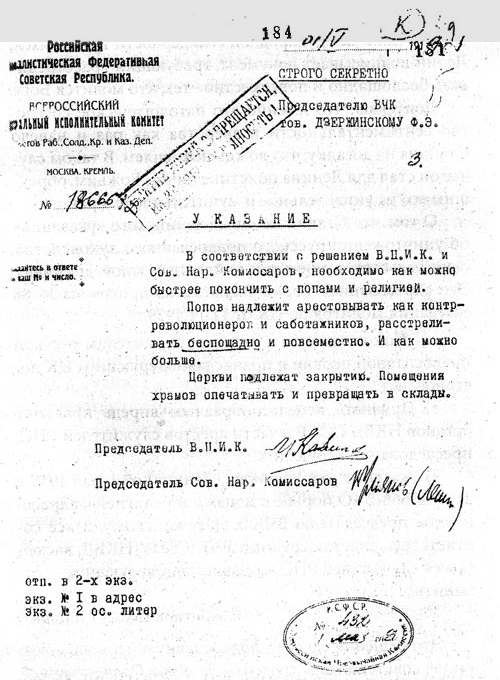
Anti-communist Anatoly Latyshev in his book “Declassified Lenin” (Анатолий Латышев «Рассекреченный Ленин») in 1996 and priest Dimitry Dudko (Димитрий Дудко, 1922 – 2004) in 1999 («Наш современник» №12, 1999-12-??) tried to portray the atheist Lenin (1870–1924) as more cruel and the believer Stalin as more merciful. They presented “documents”: “Lenin’s instruction of 1919-05-01, N 13666-2”, in which Lenin “ordered” churches to be closed and priests to be executed without mercy, and a document of 1939-11-11 in which Stalin cancelled this “Lenin’s instruction” and ordered the People’s Commissariat of Internal Affairs (НКВД) to stop persecuting believers and to release already arrested priests from custody. Igor Kurliandsky (Игорь Курляндский) claims that these documents are fabricated («Политический журнал» №32(175), 2007-11-26) – the “cancelled” document is a falsification, and therefore Stalin could not cancel it (Source).
Lenin’s instruction about the struggle against priests and religion which was “cancelled”.
Stalin’s document which “cancelled” Lenin’s instruction.
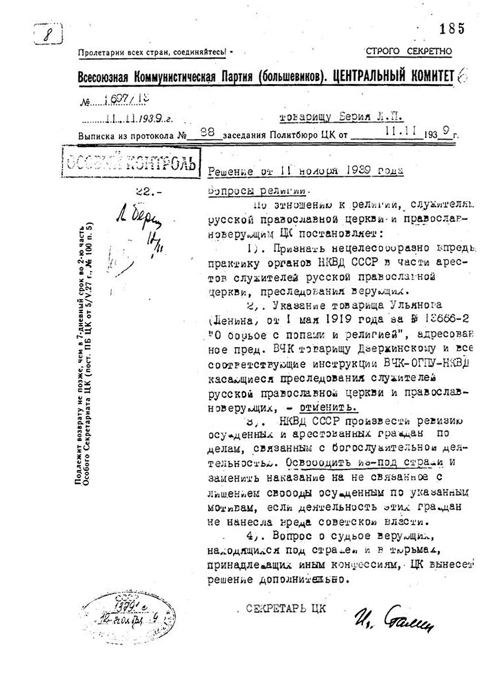
|
Extract from the minutes of the meeting of the Political bureau of the Central Committee of 1939-11-11
|
Выписка из протокола заседания политбюро ЦК от 11.11.39 г.
|
|
Religious questions
|
Вопросы религии
|
|
Concerning religion, ministers of the Russian Orthodox Church and Orthodox believers, the Central Committee decides:
|
В отношении к религии, служителям Русской Православной Церкви и православно верующим ЦК постановляет:
|
|
1) To recognise as inexpedient in the future the practice of the USSR NKVD agencies regarding arrests of ministers of the Russian Orthodox Church and persecution of believers.
|
1) Признать нецелесообразным впредь практику органов НКВД СССР в части арестов служителей русской православной церкви, преследование верующих.
|
|
2) To cancel the Instruction of comrade Ulyanov (Lenin) of 1919-05-01, №13666-2 “About the struggle against priests and religion”, addressed to the Cheka chairman comrade Dzerzhinsky, and all the corresponding Cheka–OGPU–NKVD instructions concerning persecutions of ministers of the Russian Orthodox Church and Orthodox believers.
|
2) Указание товарища Ульянова (Ленина) от 1 мая 1919 года за №13666-2 "О борьбе с попами и религией", адресованных пред. ВЧК товарищу Дзержинскому и все соответствующие инструкции ВЧК-ОГПУ-НКВД, касающиеся преследования служителей русской православной Церкви и православно верующих, – отменить.
|
|
3) The NKVD must review the cases of citizens condemned and arrested for matters connected with divine-service activity. To release from custody those condemned on the specified grounds and to replace their punishment with one not connected with imprisonment, if the activity of these citizens has not done harm to the Soviet authority.
|
3) НКВД произвести ревизию осужденных и арестованных граждан по делам, связанных с богослужительской деятельностью. Освободить из-под стражи и заменить наказание на не связанное с лишением свободы осужденным по указанным мотивам, если деятельность этих граждан не нанесла вреда советской власти.
|
|
4) On the question of the fate of believers from other confessions who are under arrest, the CC will decide additionally.
|
4) Вопрос о судьбе верующих, находящихся под стражей и в тюрьмах, принадлежащих иным конфессиям, ЦК вынесет решение дополнительно.
|
|
CC Secretary I. Stalin.
|
Секретарь ЦК И. Сталин
|
This document, in which Stalin forbade destroying churches, may also be a forgery.
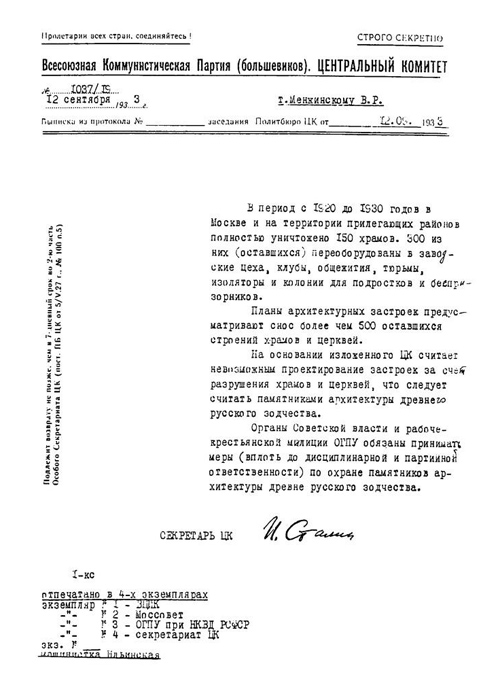
Two different typings of this “document” circulate.
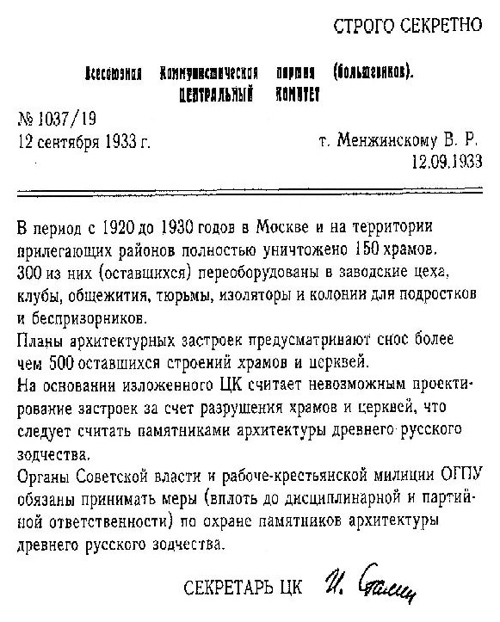
|
EXTRACT FROM the MINUTES of the MEETING of the POLITICAL BUREAU of the Central Committee of 1933-09-12
|
ВЫПИСКА ИЗ ПРОТОКОЛА ЗАСЕДАНИЯ ПОЛИТБЮРО ЦК от 12.09.33 г.
|
|
In the period from 1920 to 1930, 150 temples were completely destroyed in Moscow and on the territory of the adjoining districts. 300 of them (the remaining ones) were converted into factory workshops, clubs, hostels, prisons, isolators and colonies for teenagers and homeless children.
|
В период с 1920 до 1930 годов в Москве и на территории прилегающих районов полностью уничтожено 150 храмов. 300 из них (оставшихся) переоборудованы в заводские цеха, клубы, общежития, тюрьмы, изоляторы и колонии для подростков и беспризорников.
|
|
Plans of architectural developments intend to take down more than 500 remaining structures of temples and churches.
|
Планы архитектурных застроек предусматривают снос более чем 500 оставшихся строений храмов и церквей.
|
|
On the basis of the above, the Central Committee considers it impossible to design buildings at the cost of destroying temples and churches, which we must treat as monuments of architecture of the Old Russian heritage.
|
На основании изложенного ЦК считает невозможным проектирование застроек за счет разрушения храмов и церквей, что следует считать памятниками архитектуры древнего русского зодчества.
|
|
The agencies of the Soviet authority and the workers’ and peasants’ militia of the OGPU are obliged to take measures (up to disciplinary and party responsibility) to protect monuments of architecture of the Old Russian heritage.
|
Органы Советской власти и рабоче-крестьянской милиции ОГПУ обязаны принимать меры (вплоть до дисциплинарной и партийной ответственности) по охране памятников архитектуры древне русского зодчества.
|
|
CC Secretary I.Stalin.
|
Секретарь ЦК И. Сталин
|
Why Russians disliked priests.
Lenin (1870–1924) was an atheist and disliked religion and priests (as did many other poor Russians). Religion and priests were persecuted not for belief in God, but as a corrupt rich class and for supporting the monarchical dictatorship – the Tsar, who, according to the Church, was appointed by God to rule over Russia (like the Emperor of Japan during WW2).
Bible:NT:Romans:13:1 “Let every person be subject to the governing authorities. For there is no authority except from God, and those that exist have been instituted by God.”
The Church was against a parliamentary system of government, and the Tsar’s government hanged Lenin’s brother. Lenin had various reasons to dislike the Church, like the one below.
Berlin, 2007-06-08, Interfax – German psychologist Gunter Kruse, who in recent years has been engaged in drawing up Lenin’s family tree, maintains that one of the world proletariat leader’s great-grandmothers was burnt at the stake as a witch (Source).
Lenin tried to remove Stalin from power because of Stalin’s rudeness.
|
Vladimir Ilyich Lenin “Letter to the Congress”
|
Владимир Ильич Ленин «Письмо к съезду»
|
|
“Comrade Stalin, having become Secretary-General, has unlimited authority concentrated in his hands, and I am not sure whether he will always be capable of using that authority with sufficient caution. (1922-12-24) Stalin is too rude and this defect, although quite tolerable in our midst and in dealing among us Communists, becomes intolerable in a Secretary-General. That is why I suggest that the comrades think about a way of removing Stalin from that post and appointing another man in his stead who in all other respects differs from Comrade Stalin in having only one advantage, namely, that of being more tolerant, more loyal, more polite and more considerate to the comrades, less capricious, etc. (1923-01-04)”
|
«Тов. Сталин, сделавшись генсеком, сосредоточил в своих руках необъятную власть, и я не уверен, сумеет ли он всегда достаточно осторожно пользоваться этой властью. (24 декабря 1922 г.) Сталин слишком груб, и этот недостаток, вполне терпимый в среде и в общениях между нами, коммунистами, становится нетерпимым в должности генсека. Поэтому я предлагаю товарищам обдумать способ перемещения Сталина с этого места и назначить на это место другого человека, который во всех других отношениях отличается от тов. Сталина только одним перевесом, именно, более терпим, более лоялен, более вежлив и более внимателен к товарищам, меньше капризности и т. д. (4 января 1923 г.)»
|
Lenin was a revolutionary. He fought against the monarchy and the Church that supported it. Even now, 65% of Russians think that Lenin played a positive role in the history of their country. 26% think he played a negative role, and 9% have no opinion on the matter. Why didn’t the USSR like the church, especially after the war? The Church was flirting with the Nazis in World War Two. Pius XI signed a friendly agreement with Mussolini in 1929 and with Hitler in 1933. Fascism with Mussolini was born in the Vatican’s cradle – Italy. It is good that the USSR government didn’t see the paedophile scandals – the situation could have been worse. The Inquisition and the Crusades did not play a positive role either. The Russians took revenge on all who collaborated with the Nazis and fascists. Ordinary people didn’t know what to think. Lenin was against the Church, Stalin was for the Church. Stalin was very powerful, but he was only second in respect after Lenin – the Father of the Revolution. Therefore even Stalin could not present himself as an openly religious person, as he was the successor of Lenin’s secular heritage.
Interview with Artiom Fiodorovich Sergeev, who was raised in Stalin’s family.
|
Newspaper “ZAVTRA” №17 2006-04-26
|
Газета "ЗАВТРА" №17 2006-04-26
|
|
Ekaterina Glushik: Were there conversations about religion at home? What was Stalin’s attitude to religion: maybe, you celebrated Easter?
|
Екатерина Глушик: Велись ли дома разговоры о религии? Каким было отношение Сталина к религии: может, Пасху отмечали?
|
|
Artiom Fiodorovich Sergeev: No, we didn’t celebrate Easter or other church holidays. But expressions with a mention of God were used at home. “Thank God”, for example, “God forbid!” and “for God’s sake” Stalin himself used quite often. I never heard any bad word from Stalin about the church and belief. I remember such a case in 1931 or ’32. Opposite the school where Vasily (son of Stalin) studied, in the Second Obydensky Lane, there was a temple. Once, when there was a service, boys tried to shoot a “frightener” (a toy cap pistol) near it. Vasily did not participate in that and told his father about it. The father (Stalin) asks: “Why did they do this? They, the worshippers, do not disturb your studies. Why do you disturb their praying?” He asked Vasily further: “Do you love and respect your grandmother?” He (Vasily) answers something like: “Yes, very much, because she is your mum.” Stalin says: “She prays too.” Vasily: “Why?” The father answers him: “Because she, maybe, knows what you do not know.”
|
Артём Фёдорович Сергеев: Нет, ни Пасхи, ни других праздников церковных не отмечали. А выражения с упоминанием бога дома употреблялись. "Слава богу", например, "Не дай бог!" и "Ради бога" Сталин сам нередко говорил. Я никогда не слышал от Сталина ни одного плохого слова в адрес церкви и веры. Помню, такой случай году в 1931 или 32-м. Напротив школы, где учился Василий, во втором Обыденском переулке, был храм. Как-то, когда там шла служба, мальчишки возле пробовали стрелять из пугача. Василий в этом участия не принимал, а рассказывал отцу об этом. Отец спрашивает: "Зачем они это делали? Они же, молящиеся, вам учиться не мешают. Почему же вы им мешаете молиться?" Далее спросил Василия: "Ты бабушку любишь, уважаешь?" Тот отвечает, мол, да, очень, ведь это – твоя мама. Сталин говорит: "Она тоже молится". Василий: "Почему?" Отец отвечает ему: "Потому что она, может, знает то, чего ты не знаешь".
|
|
Stalin knew questions of religion well; he had many books, including on the history of religion. And he wrote important works on this theme. For example, in the article “Against the destruction of temples” he says that temples are monuments of the culture of our Native land, and to destroy them is to destroy monuments of culture. In the article “About the prohibition of persecution for belief” he speaks about the necessity to stop persecuting people for their belief and to let clerics out of prisons if they have committed no criminal offences. (author’s note: these “articles” are the two documents shown above, which are forgeries)
|
Сам Сталин хорошо знал вопросы религии, книг у него было немало, в том числе по вопросам и истории религии. И сам он писал важные работы на эту тему. Например, в статье "Против разрушения храмов" он говорит, что храмы – это памятники культуры нашей Родины, разрушать их – это разрушать памятники культуры. В статье "О запрещении преследования за веру" он говорит о необходимости прекратить преследования людей за веру и выпустить священнослужителей из тюрем, если за ними нет уголовных преступлений.
|
|
I was at Stalin’s funeral “from and to”, and among the people who came to say goodbye to him, there were many church ministers. They passed by the coffin in their vestments and made the sign of the cross.
|
Я был на похоронах Сталина "от и до", и среди людей, пришедших с ним попрощаться, было немало церковных служителей. Они в своих одеяниях проходили мимо гроба и крестились.
|
Stalin went to the Kremlin’s Church.
Yuri Soloviev (Юрий Соловьёв) (Stalin’s personal guard for 10 years) claimed that Stalin was a believer and that during World War Two Stalin went to the Kremlin’s Church. (French, Austrian, German and Russian documentary “Inside the Kremlin: In the Heart of Russia” by Thomas Schreiber / 2005, NDR Television in cooperation with Channel 1 Russia). It could have been between 1941 and 1945.
|
Narrator: “This man too once served in the security of the Kremlin. Yuri Soloviev. He was Joseph Stalin’s personal bodyguard for more than ten years. Also, he was responsible for Stalin’s security at the famous Potsdam Conference. During filming, Yuri Soloviev showed us the place in the Grand Kremlin Palace that stayed in his memory forever. Behind these bars – a small church. During World War II, it was the place of a surprising event. Stalin came here often.”
|
Ведущий: «Этот человек когда-то тоже служил в охране Кремля. Юрий Соловьёв. Более десяти лет он был личным охранником Иосифа Сталина. За безопасность Сталина он отвечал и на знаменитой Потсдамской Конференции. Во время съёмок Юрий Соловьёв показал нам то место в Большом Кремлёвском Дворце, которое навсегда осталось в его памяти. За этой решеткой – маленькая церковь. Во время Отечественной Войны она была местом удивительного события. Сюда часто заходил Сталин.»
|
|
Yuri Soloviev: “He came here only when he was alone, without an escort. Here, he attended, apparently, to his spiritual needs. Here, it was always possible to reach out for church books, come (closer) to Anastasius (Saint Anastasius of Sinai). Well, he is a believing human.”
|
Юрий Соловьёв: «Он заходил только тогда, когда он шел один, без свиты. Здесь он отправлял, видимо, духовные свои потребности. Здесь можно было всегда протянуть руки к церковным книгам, подойти к Анастасу (Святой Анастасий Синаит). Ну, он – человек верующий.»
|
|
Narrator: “Yuri Soloviev honours Stalin to this day.”
|
Ведущий: «Юрий Соловьёв почитает Сталина и по сегодняшний день.»
|
According to Stalin’s grandson Alexander Burdonsky, Stalin confessed.
|
Moskovsky Komsomolets number 25303 of 2010-03-17; E. Svetlova, “Stainless Stalin”
Alexander Burdonsky: “Stalin was a very clever man; he knew well and understood what he was doing. It would be interesting for me to understand what he was thinking when he sat for hours at night in a chair and looked out of the window, which faced the woods. What kind of thoughts went through his mind? Why did he want to confess? After all, there was a confession. The priest was interrogated under Khrushchev with terrible force, but he said nothing.”
|
Московский Комсомолец № 25303 от 17 марта 2010 г. Светлова Е. "Нержавеющий Сталин"
Александр Бурдонский: "Сталин был очень умным человеком, он хорошо знал и понимал, что делает. Мне было бы интересно понять, что он думал, когда часами сидел ночью в кресле и смотрел в окно, которое выходило на лес. Какие мысли он перебирал? Почему он захотел исповедаться? Ведь исповедь была. Священника трясли при Хрущеве со страшной силой, но он ничего не сказал."
|
Stalin went to the Temple of All Saints to pray.
|
Newspaper “Moscow Falcon” №1(77) 2005-01-??; Sofia Pavlova “The only church visited by Stalin...”
|
Газета «Московский Сокол» №1(77) 2005-01-??; София Павлова «Единственный храм, где бывал Сталин…»
|
|
The churchwarden of the Temple of All Saints, Michael Aleksandrovich Rodin: “Joseph Vissarionovich himself came to our temple during the war to pray. And even today some parishioners are alive – a few very old people who remember this fact and saw Stalin themselves. Stalin, as they tell, came to the temple three times and stood for a long time facing two icons – Nicholas the Wonderworker and the Kazan Mother of God. Joseph Vissarionovich did not stand through the whole service; his visits lasted 15–20 minutes.”
|
Староста Храма Всех Святых Михаил Александрович Родин: "Сам Иосиф Виссарионович заезжал во время войны в наш храм помолиться. У нас и сегодня живы прихожане – несколько очень пожилых людей, которые помнят этот факт и сами видели Сталина. Сталин, как рассказывают, приезжал в храм трижды и подолгу стоял перед двумя иконами – Николая Чудотворца и Казанской Божьей Матери. Всю службу Иосиф Виссарионович не выстаивал, его визиты длились минут по 15-20."
|
Resurrection of churches under Stalin.
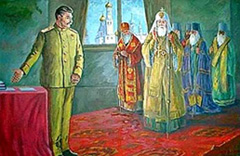
In 1943 Stalin started to organise meetings with priests and initiated the reopening of churches, seminaries and academies and the publishing of religious magazines at “Bolshevik speed” (as quickly as possible) (Сталин: "А нельзя ли проявить большевистские темпы?") and promised full support. There are some documented conversations from these meetings:
|
M.I.Odintsov “Russian patriarchs of the 20th century”, 1994, №34: note of G.G.Karpov about J.V.Stalin’s reception of the hierarchs of the Russian Orthodox Church, p. 286
|
Одинцов М.И. "Русские патриархи ХХ века." 1994 год, №34 записка Г.Г.Карпова о приеме И.В.Сталиным иерархов Русской Православной Церкви стр. 286
|
|
“Comrade Stalin said: ‘Well, as you want, this is your business, and if you want theological courses, begin with them, but the Government will not object to opening seminaries and academies either.’”
|
"Тов. Сталин сказал: "Ну, как хотите, это дело ваше, а если хотите богословские курсы, начинайте с них, но Правительство не будет иметь возражений и против открытия семинарий и академий."
|
|
“Comrade Stalin said that the church can count on the comprehensive support of the Government in all questions connected with its organisational strengthening and development inside the USSR, and that, as he had spoken about the organisation of spiritual educational institutions, not objecting to the opening of seminaries in the dioceses, so there can be no obstacles to opening candle factories and other workshops at the diocesan administrations either.”
|
"Тов. Сталин сказал, что церковь может рассчитывать на всестороннюю поддержку Правительства во всех вопросах, связанных с ее организационным укреплением и развитием внутри СССР, и что, как он говорил об организации духовных учебных заведений, не возражая против открытия семинарий в епархиях, так не может быть препятствий и к открытию при епархиальных управлениях свечных заводов и других производств."
|
|
“Then, addressing me, comrade Stalin said: ‘It is necessary to provide the right for the bishop to dispose of church sums (money). There is no need to put obstacles in the way of the organisation of seminaries, candle factories, etc.’”
|
"Затем, обращаясь ко мне, т. Сталин сказал: "Надо обеспечить право архиерея распоряжаться церковными суммами. Не надо делать препятствий к организации семинарий, свечных заводов и т. д."
|
Stalin’s marks in books.
The English historian Simon Sebag Montefiore studied Stalin’s hobbies, his personal library, what Stalin liked to read and what kind of marks he left in his books. He found that Stalin liked to quote long passages from the Bible. Stalin left such a mark about God in the book “Last Pages. Dialogues under the Rose” by Anatole France: “Don’t know traces, don’t see. There is no Him for them.” ("Следов не знают, не видят. Его для них нет."). It seems as if Stalin thought that, unlike others, he knew God’s traces and saw God.
Antireligious literature for Stalin is waste paper.
|
M.V.Shkarovskii “The Russian Orthodox Church under Stalin and Khrushchev”, p. 201
Before the war, selecting a library for his summer residence, Stalin added a note for the executors: “Please, no atheistic waste paper at all!”. It is known absolutely reliably, for example, that Stalin liked to quote the Bible from time to time.
|
М.В.Шкаровский "Русская Православная Церковь при Сталине и Хрущеве" с. 201
Перед войной, подбирая библиотеку для дачи, Сталин приписал для сведения исполнителей: «Прошу, чтобы не было никакой атеистической макулатуры!». Совершенно достоверно известно, например, что Сталин временами любил цитировать Библию.
|
|
Photocopy in the magazine “Modern and Contemporary History” (historian B.S.Ilizarov).
Book “Stalin” by Dmitri Antonovich Volkogonov.
“A note to the librarian (Ivan Pavlovich Tovstukha). My advice (and request):
...
3) All the others (books) to classify by authors (excluding from the classification and putting aside: all kinds of textbooks, small magazines, antireligious waste paper, etc.). 29.V.25. I.Stalin”.
|
Фотокопия в журнале «Новая и новейшая история» (историк Б.С.Илизаров).
Волкогонов Дмитрий Антонович – Книга "Сталин".
«Записка библиотекарю (Иван Павлович Товстуха). Мой совет (и просьба):
...
3) Все остальные склассифицировать по авторам (исключив из классификации и отложив в сторону: учебники всякие, мелкие журналы, антирелигиозную макулатуру и т. п.). 29.V.25 г. И. Сталин».
|
Stalin’s friends and comrades talk about Stalin.
|
One hundred and forty conversations with Molotov: from the diary of F.Chuev, 1991, ISBN 5-85255-042-6
|
Сто сорок бесед с Молотовым: Из дневника Ф. Чуева 1991 ISBN 5-85255-042-6
|
|
Felix Ivanovich Chuev: Chief Marshal of Aviation A.E.Golovanov told me that after the rout of the Germans near Moscow, Stalin said: “God grant that we finish this war in 1946.” [p. 31]
|
Феликс Иванович Чуев: Главный маршал авиации А.Е. Голованов говорил мне, что после разгрома немцев под Москвой Сталин сказал: «Дай бог нам эту войну закончить в 1946 году». [с. 31]
|
|
Vyacheslav Mikhaylovich Molotov: Why even Molotov? Even Stalin, even Voroshilov and Molotov – all three sang! All three of us were choristers in church. Stalin, and Voroshilov, and I. In different places, of course. Stalin – in Tbilisi, Voroshilov – in Lugansk, I – in my Nolinsk. (...) So we three sang. “Let your prayer arise…” – and so on. Very good music, church singing. [p. 123]
|
Вячеслав Михайлович Молотов: Почему даже Молотов? Даже Сталин, даже Ворошилов и Молотов трое пели! Мы все трое были певчими в церкви. И Сталин, и Ворошилов, и я. В разных местах, конечно. Сталин – в Тбилиси, Ворошилов – в Луганске, я – в своем Нолинске. (...) Вот мы трое пели. «Да исправится молитва твоя…» – и так далее. Очень хорошая музыка, пение церковное. [с. 123]
|
|
Felix Ivanovich Chuev: Our commanders told me that before a battle Stalin, giving parting words, usually said: “Well, God grant!” or “Well, Lord, help!” And the writer Vladimir Soloukhin, who served in the Kremlin during the war, said: “Joseph Vissarionovich went out onto the porch. On his left – Patriarch Aleksy, on his right…” – “Probably, Molotov?” – I asked. – “...The Metropolitan of Krutitsy and Kolomna,” – Vladimir Alekseevich answered without blinking. – “And why are you laughing? He (Stalin) respected priests. His seminary education showed...” [pp. 269–270]
|
Феликс Иванович Чуев: Мне наши полководцы рассказывали, что Сталин перед [с. 269] сражением, напутствуя, обычно говорил: «Ну, дай бог!», или «Ну, помоги господь!». А писатель Владимир Солоухин, служивший во время войны в Кремле, рассказывал: «Выходит на крыльцо Иосиф Виссарионович. По левую руку – патриарх Алексий, по правую…» – «Наверно, Молотов?» – спросил я. «Митрополит Крутицкий и Коломенский, – не моргнув, ответил Владимир Алексеевич. – А что ты смеешься? Он попов уважал. Сказывалось семинарское образование…» [с. 270]
|
|
Vyacheslav Mikhaylovich Molotov: It is necessary to say that Stalin was not a militant atheist either. Certainly, first of all, he was a revolutionary and continued Lenin’s line against popovshchina*. [p. 269]
|
Вячеслав Михайлович Молотов: Надо сказать, и Сталин не был воинственным безбожником. Конечно, прежде всего, он был революционером и продолжал линию Ленина против поповщины. [с. 269]
|
|
*Popovshchina (from pop, priest): Lenin’s contemptuous word for clericalism.
|
|
Christian songs and Christianity.
|
Alexander Mikhailovich Orlov
“The Secret History of Stalin’s Crimes”
“Once he (Pavel Alliluev – brother of Stalin’s wife) mentioned that Stalin, drunk on vodka, would start singing spiritual hymns.”
|
Александр Михайлович Орлов
«Тайная история сталинских преступлений»
"Он (Павел Аллилуев) как-то упомянул о том, что Сталин, опьянев от водки, начинал распевать духовные гимны."
|
|
I.V.Stalin, A.A.Zhdanov, V.M.Molotov
Conversation with S.M.Eisenstein and N.K.Cherkasov about the movie “Ivan the Terrible” on 1947-02-26
Source: I.V.Stalin “Works”; Volume 18; Tver: Information-publishing centre “Union”, 2006, pp. 433–440
Stalin: “May god give you a New Year every day.” (p. 434)
Stalin: Certainly, we are not very good Christians, but it is impossible to deny the progressive role of Christianity at a certain stage. This event had a very great significance, because it was a turn of the Russian state towards merging with the West, instead of an orientation to the East. (p. 435)
|
И.В.Сталин, А.А.Жданов, В.М.Молотов
Беседа с С.М.Эйзенштейном и Н.К.Черкасовым по поводу фильма «Иван Грозный» 26 февраля 1947 года
Источник: И.В.Сталин – Сочинения; Том 18; Тверь: Информационно-издательский центр «Союз», 2006, с. 433–440.
Сталин: «Дай вам бог, каждый день – новый год.» (с. 434)
Сталин: Конечно, мы не очень хорошие христиане, но отрицать прогрессивную роль христианства на определенном этапе нельзя. Это событие имело очень крупное значение, потому что это был поворот русского государства на смыкание с Западом, а не ориентация на Восток. (с. 435)
|
|
The conversation comes to an end when Stalin wishes success and says: “May god help you!” (p. 440)
|
Разговор кончается тем, что Сталин желает успеха и говорит: «Помогай бог!» (с. 440)
|
Stalin was proud that Georgia had accepted Orthodoxy earlier than Russia.
|
WAR, CHURCH, STALIN AND THE GREAT INTERCESSOR FOR ORTHODOX RUSSIA, METROPOLITAN OF MOUNT LEBANON ILIA (KARAM). Sergey FOMIN 2003-03-21
|
ВОЙНА, ЦЕРКОВЬ, СТАЛИН И ВЕЛИКИЙ МОЛИТВЕННИК ЗА РУСЬ ПРАВОСЛАВНУЮ, МИТРОПОЛИТ ГОР ЛИВАНСКИХ ИЛИЯ (КАРАМ). Сергей ФОМИН 2003-03-21
|
|
It is known absolutely reliably, for example, that Stalin liked to quote the Bible from time to time. It happened that even in front of his closest circle (certainly, in front of those who could appreciate this somehow) Stalin “was proud” that Georgia had accepted Orthodoxy much earlier than Russia. (...). A.I.Mikoyan (1895–1978), who belonged to Stalin’s closest circle, was also a former seminarian: he finished the Tbilisi theological seminary in 1916 and studied at a spiritual academy.
|
Совершенно достоверно известно, например, что Сталин временами любил цитировать Библию. Бывало, даже перед ближайшим окружением (разумеется, перед теми, кто мог это хоть в какой-то мере оценить) "гордился", что Грузия приняла православие много раньше, чем Россия. (...). Входивший в ближайшее окружение И. В. Сталина А. И. Микоян (1895-1978) был также из семинаристов: в 1916 г. он окончил Тифлисскую духовную семинарию, учился в духовной академии.
|
Stalin and Winston Churchill.
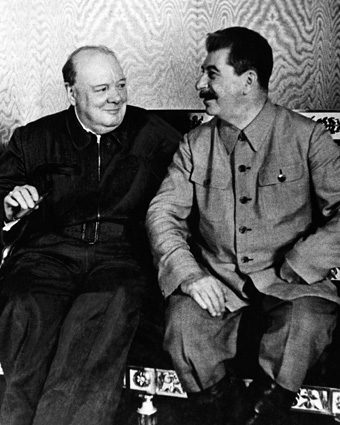
|
Winston Churchill: “The Second World War, Volume 4 – The Hinge of Fate, Book 2 – Africa Redeemed, Chapter 27 – Moscow: The First Meeting” (1950)
|
Черчилль Уинстон: «Вторая мировая война, Том 4. Поворот Судьбы, Часть 2. Африка освобождена, Глава 4. Москва: Первая встреча» (1991)
|
|
(1942-08) To illustrate my point I had meanwhile drawn a picture of a crocodile, and explained to Stalin with the help of this picture how it was our intention to attack the soft belly of the crocodile as we attacked his hard snout. And Stalin, whose interest was now at a high pitch, said, “May God prosper this undertaking.”
|
(1942 август) Чтобы проиллюстрировать свои разъяснения, я тем временем нарисовал крокодила и объяснил Сталину с помощью этого рисунка, как мы намереваемся атаковать мягкое брюхо крокодила, в то время как мы атакуем его жесткую морду. Сталин, который был теперь очень заинтересован, сказал: «Дай бог, чтобы это предприятие удалось».
|
|
Winston Churchill: “The Second World War, Volume 4 – The Hinge of Fate, Book 2 – Africa Redeemed, Chapter 28 – Moscow: A Relationship Established” (1950)
|
Черчилль Уинстон: «Вторая мировая война, Том 4. Поворот Судьбы, Часть 2. Африка освобождена, Глава 5. Москва: Отношения установлены» (1991)
|
|
He smiled amicably, so I said, “Have you forgiven me?” “Premier Stalin, he say,” said Interpreter Pavlov, “all that is in the past, and the past belongs to God.”
|
Он дружелюбно улыбнулся, и тогда я спросил: «Вы простили меня?» «Премьер Сталин говорит, — перевел Павлов, — что все это относится к прошлому, а прошлое принадлежит богу».
|
Letter to Kosygin.
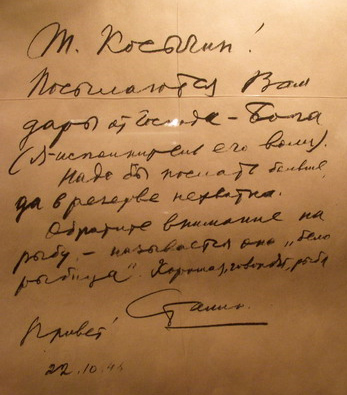
|
Dmitry Petrovich Savchenko (military journalist) – “The civilian ‘marshal Zhukov’ of the Great Victory”, 2005-04-08, “The Independent Newspaper”
|
Дмитрий Петрович Савченко (военный журналист) – "Гражданский "маршал Жуков" Великой Победы", 2005-04-08 "Независимая газета"
|
|
Letter to Aleksey Kosygin (1948-10-22)
C.(omrade) Kosygin! Gifts from lord-God are sent to you (I am an executor of His will). It would be necessary to send more, but there is a shortage in reserve. Pay attention to the fish – it is called “whitefish”. A good fish, (people) say.
|
Письмо Алексею Косыгину (1948-10-22)
Т. Косыгин! Посылаются Вам дары от господа-Бога (я – исполнитель его воли). Надо бы послать больше, да в резерве нехватка. Обратите внимание на рыбу, – называется она "белорыбица". Хорошая, говорят, рыба.
|
|
Greetings! Stalin.
|
Привет! Сталин.
|
Stalin Peace Prize.
Stalin “hated” religion so much that on 1951-04-06 he gave the “Stalin Peace Prize” (Международная Сталинская премия «За укрепление мира между народами») to the English clergyman Hewlett Johnson and to Arthur Moulton, a former Protestant bishop from the USA («Красный флот», 1951-04-07). Other priests also received various prizes under Stalin and the Soviet authority.
Stalin’s “pure atheistic” funeral.
The representatives of the Russian Orthodox Church – Metropolitan Nikolai (Николай), Archbishop Nikon (Никон) and protopresbyter Nikolai Kolchitsky (Николай Колчицкий) – part of the honour guard at the coffin of Joseph Stalin.
Journal of the Moscow Patriarchate (JMP), 1953, №3, p. 5; №4, pp. 3–4 (Журнал Московской Патриархии (ЖМП), 1953, №3, стр. 5; №4, стр. 3-4)
|
Documentary film “How Stalin died”, 2008, Russia, director Sergey Kostin, presenter Armen Dzhigarkhanyan.
“Farewells to Stalin were organised in temples too. The first requiem, for the family, was in the Church of the Resurrection of the Word in Filippovsky Lane. It was ordered by Vasily Stalin. The second, official one was in the Elokhovsky Cathedral, served by Patriarch Aleksy himself. Requiems for communist leaders had never been served in Soviet Union churches before.”
|
Документальный фильм "Как умер Сталин", 2008, Россия, режиссер Сергей Костин, ведущий Армен Джигарханян.
"Со Сталиным прощались и в храмах. Первая заупокойная служба в церкви Воскресения Словущего в Филипповском переулке была семейной. Ее заказал Василий Сталин. Вторая была официальной в Елоховском Кафедральном соборе и отслужил ее сам патриарх Алексий. Никогда до этого ни в одной церкви Советского Союза не служили панихиды по коммунистическим вождям."
|
|
From the speech of His Holiness Patriarch Aleksii of Moscow and All Russia before the requiem for I.V.Stalin, delivered in the patriarchal cathedral on the day of Stalin’s funeral (1953-03-09).
|
Из речи святейшего патриарха Московского и всея Руси Алексия перед панихидой по И.В.Сталине, сказанная в патриаршем соборе в день его похорон (9.03.1953 г.).
|
|
“(...) We, who have gathered to pray for him, cannot pass over in silence his always benevolent, sympathetic attitude to our church needs. No question with which we turned to him was rejected by him; he satisfied all our requests. And a lot of good and useful things, thanks to his high authority, have been done for our Church by our Government.
|
"(...) Мы же, собравшись для молитвы о нем, не можем пройти молчанием его всегда благожелательного, участливого отношения к нашим церковным нуждам. Ни один вопрос, с которым бы мы к нему ни обращались, не был им отвергнут; он удовлетворял все наши просьбы. И много доброго и полезного, благодаря его высокому авторитету, сделано для нашей Церкви нашим Правительством.
|
|
The memory of him is unforgettable for us, and our Russian Orthodox Church, mourning his departure from us, escorts him on his last way, “the way of all the earth”, with fervent prayer.
|
Память о нем для нас незабвенна, и наша Русская Православная Церковь, оплакивая его уход от нас, провожает его в последний путь, "в путь всея земли", горячей молитвой.
|
|
In these days, sad for us, from different parts of our Fatherland, from bishops, clergy and believers, and from abroad, from Heads and representatives of Churches, both Orthodox and heterodox, I receive a mass of telegrams which inform of prayers for him and condole with us on the occasion of this loss, sad for us. We prayed for him when the news of his grave illness came. And now, when he is no more, we pray for the peace of his immortal soul.
|
В эти печальные для нас дни со всех сторон нашего Отечества от архиереев, духовенства и верующих, и из-за границы от Глав и представителей Церквей, как православных, так и инославных, я получаю множество телеграмм, в которых сообщается о молитвах о нем и выражается нам соболезнование по случаю этой печальной для нас утраты. Мы молились о нем, когда пришла весть об его тяжкой болезни. И теперь, когда его не стало, мы молимся о мире его бессмертной души.
|
|
Yesterday our special delegation, composed of His Eminence Metropolitan Nikolai; the representative of the episcopate, clergy and believers of Siberia, Archbishop Palladius; the representative of the episcopate, clergy and believers of Ukraine, Archbishop Nikon; and protopresbyter Father Nikolai, laid a wreath at his coffin and bowed on behalf of the Russian Orthodox Church to his dear remains.
|
Вчера наша особая делегация в составе Высокопреосвященного митрополита Николая; представителя епископата, духовенства и верующих Сибири архиепископа Палладия; представителя епископата, духовенства и верующих Украины архиепископа Никона и протопресвитера о. Николая, возложила венок к его гробу и поклонилась от лица Русской Православной Церкви его дорогому праху.
|
|
A prayer filled with Christian love reaches God. We believe that our prayer for the deceased will also be heard by the Lord. And to our beloved and unforgettable Joseph Vissarionovich we devoutly, with deep, passionate love, proclaim eternal memory.”
|
Молитва, преисполненная любви христианской, доходит до Бога. Мы веруем, что и наша молитва о почившем будет услышана Господом. И нашему возлюбленному и незабвенному Иосифу Виссарионовичу мы молитвенно, с глубокой, горячей любовью возглашаем вечную память."
|
Stalin the saint.
 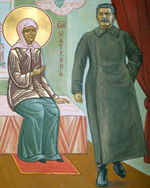 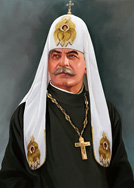
So, Stalin’s love of religion was not just right before his death, but started much earlier. Some people say that Stalin revived religion just because Hitler in Germany planned to attack Russia (but then it is strange why, after Germany had attacked the USSR’s borders, Stalin for some time could not even believe it and argued that it was just enemy propaganda). Or, maybe, he told stories of Christ to his daughter Svetlana because he was afraid of Hitler too? But even if so... it seems that Stalin understood the power of religion and... if you want to send people to death and kill others... the best help for that purpose can be provided by... religion. When people know that Heaven is waiting for them after death – they can die with a smile on their face. For his positive contribution to religion and the re-creation of the church in Russia, some groups even started an initiative to declare Stalin a saint.
Stalin, Evolution and Grigory Glurdzhidze.
It is necessary to say that religion often perverts the understanding of Evolution by claiming that “the strongest, the most ruthless, the cruellest” and so on survive... by putting in the heads of people such an understanding of the “real” laws of life. In reality... during Evolution, beings with characteristics best suited to their environment survive. Therefore, if honesty, decency and usefulness are more appreciated in a society, the society will care more about a person who has such characteristics, and therefore such a person will have better chances of survival.
Stalin spoke about God and Evolution with his friend Grigory Glurdzhidze during the summer holidays when they were both 13 years old (1892-6...8-??, 4th class of Gori Church School).
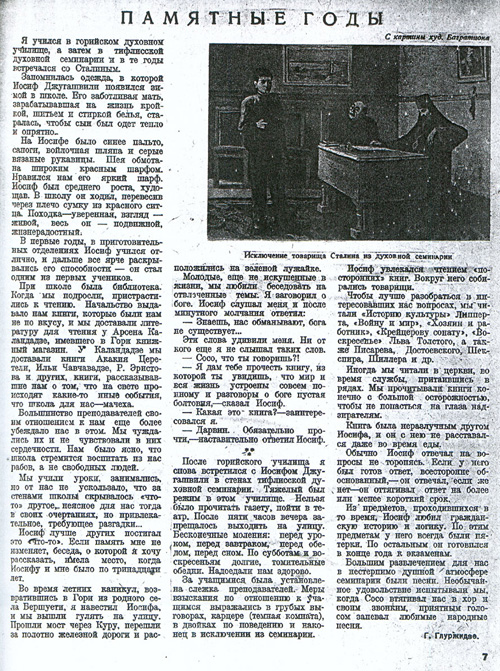
|
“Memorable years”. G.Glurdzhidze (magazine “Godless” N4 1938)
Joseph comprehended that “Something” better than others. If my memory doesn’t fail me, the conversation I want to tell about took place when Joseph and I were thirteen years old.
During the summer holidays, having come back to Gori from my native village Vershueti, I visited Joseph, and we went out for a walk in the street. We crossed the bridge over the Kura river, crossed the railway and settled down on a green lawn.
Young, not yet experienced in life, we liked to talk about abstract themes. I started talking about God. Joseph listened to me and after a minute of silence answered:
– You know, we are deceived, god doesn’t exist...
These words surprised me. I had never heard such words from anybody.
– Soso, what are you saying?!
– I will give you a book to read, from which you will see that the world and all life are arranged absolutely differently and conversations about God are empty talk, – Joseph said.
– Which book is this? – I asked, interested.
– Darwin. Be sure to read it, – Joseph answered instructively.
|
"Памятные годы". Г.Глурджидзе (журнал "Безбожник" N4 1938 год)
Иосиф лучше других постигал это “Что-то”. Если память мне не изменяет, беседа, о которой я хочу рассказать, имела место, когда Иосифу и мне было по тринадцати лет.
Во время летних каникул, возвратившись в Гори из родного села Вершуети, я навестил Иосифа, и мы вышли гулять на улицу. Прошли мост через Куру, перешли за полотно железной дороги и расположились на зеленой лужайке.
Молодые, еще не искушенные в жизни, мы любили беседовать на отвлеченные темы. Я заговорил о боге. Иосиф слушал меня и после минутного молчания ответил:
– Знаешь, нас обманывают, бога не существует...
Эти слова удивили меня. Ни от кого еще я не слышал таких слов.
– Сосо, что ты говоришь?!
– Я дам тебе прочесть книгу, из которой ты увидишь, что мир и вся жизнь устроены совсем по-иному и разговоры о боге пустая болтовня, – сказал Иосиф.
– Какая это книга? – заинтересовался я.
– Дарвин. Обязательно прочти, – наставительно ответил Иосиф.
|
Yes, it is an anti-religious speech (as G.Glurdzhidze told us about Stalin). But it seems that Darwin’s book did not have a LONG-LASTING impact on Stalin. Even the Pope in the Vatican officially accepted Darwin’s theory of Evolution and admitted that it does not contradict Christianity. It looks as if Stalin found some similar solution between Evolution and Christianity, as the Pope did later ...maybe, with the help of other believers. Because, after this speech in 1892, Stalin (as an “atheist”?) continued to go to Gori Church School and finished it with honours in 1894-06-??. Therefore, he was recommended to enter the Tbilisi Priest Seminary and entered it on 1894-09-01 (and studied there until 1899-05-29). Stalin started as a good student in the Seminary too. In the first year, he took 8th place in his class. In the second year, he took an even higher 5th place. Only in the third year did Stalin start to have problems and drop to 16th place. Also, Stalin entered the Seminary against his father’s wish:
|
Alexander Ostrovsky – “Who was behind Stalin?” 2002 (page 103 and photo 11)
Seminarian Joseph Dzhugashvili wrote in his petition to Rector Serafim on 1895-08-28:
“My father has not supported me with parental care for three years already, as a punishment because I continued my education not in accordance with his wish... (...) ... Therefore, I again resort to Your Reverence’s feet and humbly ask you to help me by accepting me at full government expense, by which you will do the greatest mercy.”
|
Александр Островский – «Кто стоял за спиной Сталина? » 2002 (с. 103 и фото 11)
В прошении на имя ректора Серафима семинарист Иосиф Джугашвили 28 августа 1895 года пишет:
«Отец мой уже три года не оказывает мне отцовского попечения в наказание за то, что я не по его желанию продолжил образование… (...) ...Посему я вторично прибегаю к стопам Вашего Высокопреподобия и прошу покорнейше оказать мне помощь принятием на полный казённый счёт, чем окажете величайшую милость»
|
Stalin’s later, consistent behaviour and personal notes show that he was not an atheist, but a believer, or that he returned to belief in God. Maybe Stalin’s temporary atheistic behaviour was influenced by events a few months before (1892-02-13), when he expressed his belief in God and justice:
|
Evgenie Mironov, “Gen-Secretary-traitor” 2008
On 1892-02-13 a crowd gathered at a scaffold where the public execution of two criminals was arranged. It was considered that “the execution show should inspire a feeling of the inevitability of punishment, fear of crime”. Peter Kapanadze – a pupil of the Gori church school – remembered: “The teachers considered that it would inspire a sense of fear and humility in the youth. But the picture of the execution strengthened in us even more our discontent with the regime which reigned in the church school. We were terribly depressed by this scene of execution; our eyes were dimmed by tears. Young Joseph Dzhugashvili was with us. We hotly discussed the events of this day. The sermons of the church school teachers, the precept ‘don’t kill’ and all similar things didn’t fit in any way in our understanding... with the public execution of two peasants nicknamed robbers, with the figure of the priest escorting the condemned. During the execution the rope broke, but they hanged him a second time”.
...
The execution was widely discussed in the city and among the students. – It seems that, by all the canons, being guided by the commandment “don’t kill”, the cleric should have prevented an act not pleasing to God, but the priest BETRAYED the two peasants, the gathered crowd and God. – This execution convinced Joseph once again that the infringement of Christian commandments is an ordinary phenomenon.
|
Евгений Миронов, "Генсек-предатель" 2008
13.02.1892 г. толпа собралась у помоста, где устраивалась публичная казнь двух преступников. Считалось, что «зрелище казни должно внушать чувство неотвратимости возмездия, боязнь преступления». Петр Капанадзе – учащийся Горийского духовного училища – вспоминал: «Преподаватели считали, что это внушит молодежи чувство страха и покорность. Но картина казни еще более укрепила в нас недовольство тем режимом, который царил в духовном училище. Мы были страшно подавлены сценой казни, глаза застилали слезы. С нами вместе был юный Иосиф Джугашвили. Мы горячо обсуждали события этого дня. Проповеди учителей духовного училища, заповедь «не убий» и все подобное никак не увязывалось в нашем представлении с публичной казнью двух крестьян, прозванных разбойниками, с фигурой священника, сопровождавшего осужденных. Во время казни оборвалась веревка, но повесили во второй раз».
...
Казнь широко обсуждалась и в городе и в ученической среде. – Вроде бы, по всем канонам, руководствуясь заповедью – не убий, священнослужитель должен бы воспрепятствовать не богоугодному деянию, но священник ПРЕДАЛ и двух крестьян и собравшуюся толпу и Бога. – Иосифа данная казнь лишний раз убедила, что нарушение христианских заповедей – обыденное явление.
|
|
G.Razmadze: “It was, apparently, in 1892. Policemen caught three Ossetians who were robbing in the Gori district. A public execution was appointed on the bank of the Liakhvi river. (...). This terrible picture made a most painful impression on us children. Coming back from the place of execution, we began to discuss what would happen to the hanged in the next world. Whether they would be fried on a slow fire. Soso Dzhugashvili resolved our doubts: They – he said thoughtfully – have already been punished, and it would be unfair of God to punish them again.”
|
Г.Размадзе: “Было, это, кажется, в 1892 году. Стражники поймали трех осетин, разбойничавших в Горийском уезде. На берегу Лиахвы назначена была публичная казнь. (...). Эта жуткая картина произвела на нас, детей, самое тяжелое впечатление. Возвращаясь с места казни, мы стали обсуждать, что будет с повешенными на том свете. Будут ли их жарить на медленном огне. Сосо Джугашвили разрешил наши сомнения: Они, – сказал он, задумавшись, – уже понесли наказание, и будет несправедливо со стороны Бога наказывать их опять.
|
Why was Stalin so cruel?
A violent father, the Church School and the Priest Seminary formed his view of the World and of how he can treat it. This had an impact on his actions:
|
I.V.Stalin remembered: “In protest against the outrageous regime and the Jesuitical methods prevalent at the seminary, I was ready to become, and actually did become, a revolutionary, a believer in Marxism (author’s note: NOT Atheism!) as a really revolutionary teaching.”
Talk with the German author Emil Ludwig, 1931-12-13 (J. V. Stalin, Works, vol. 13)
|
И.В. Сталин вспоминал: "Из протеста против издевательского режима и иезуитских методов, которые имелись в семинарии, я готов был стать и действительно стал революционером, сторонником марксизма, как действительно революционного учения."
Беседа с немецким писателем Эмилем Людвигом, 13 декабря 1931 г. (И. В. Сталин, Сочинения, т. 13)
|
So, for Stalin being who he was, we can thank... the Priest Seminary and its inhuman regime.
Stalin about Evolution and God.
At one meeting later (1924), Stalin said that it is not enough to explain how nature works to prove that God does not exist. Maybe inside he felt the same about Darwin’s book:
|
Meeting of secretaries of rural cells at the Central Committee of the RKP(b); 1924-10-22, I.Stalin (Works, vol. 6)
|
Совещание секретарей деревенских ячеек при ЦК РКП(б); 22 октября 1924 г., И.Сталин (Сочинения, т. 6)
|
|
Stalin: “Occasionally, some comrades are inclined to regard the peasants as materialist philosophers and to think that it is enough to deliver a lecture on natural science to convince the peasant of the nonexistence of God. Often they fail to realise that the peasant looks on God in a practical way, i.e., he is not averse to turning away from God sometimes, but he is often torn by doubt: ‘Who knows, maybe there is a God after all. Would it not be better to please both the Communists and God, as being safer for my affairs?’”
|
Сталин: "Иногда некоторые товарищи рассматривают крестьян как философов-материалистов, полагая, что стоит прочесть лекцию по естествознанию, чтобы убедить мужика в несуществовании бога. Они не понимают часто, что мужик смотрит на бога по-хозяйски, т.е. мужик иногда не прочь бы отвернуться от бога, но его часто раздирают сомнения: "а кто его знает, может, бог и в самом деле существует; не лучше ли будет ублаготворить и коммуниста, и бога, чтобы надежнее было для хозяйства."
|
Stalin’s own words against religion.
|
Interview with the First American Trade Union Delegation, 1927-09-09, I.Stalin (“Pravda”, 1927-09-15; English: Workers Library, 1927)
|
Беседа с первой американской рабочей делегацией, 9 сентября 1927 г., И.Сталин («Правда», 15 сентября 1927 г.; Сочинения, т. 10, с. 131–132)
|
|
Stalin: “(...) speaking formally, we have no conditions of Party membership which demand that a candidate for Party membership shall be an Atheist. (...)”
A delegate: “I often read of expulsions from the Party because of belief in God.”
Stalin: “(...) Does that mean the Party is neutral towards religion? No, it does not. We carry on and will continue to carry on propaganda against religious prejudices. (...) The Party cannot be neutral towards religion and does conduct anti-religious propaganda against all and every religious prejudice because it stands for science, while religious prejudices run counter to science, because all religion is something opposite to science. Cases such as recently occurred in America in which Darwinists were prosecuted in court, cannot occur here because the Party carries out a policy of the general defense of science.”
|
Сталин: «(...) говоря формально, у нас нет таких условий приема в члены партии, которые бы требовали от кандидата в члены партии обязательного атеизма. (...)»
Один из делегатов: «Я очень часто читаю, что исключают из партии за то, что верят в бога.»
Сталин: «(...) Значит ли это, что партия нейтральна в отношении религии? Нет, не значит. Мы ведем пропаганду и будем вести пропаганду против религиозных предрассудков. (...) Партия не может быть нейтральна в отношении религии, и она ведет антирелигиозную пропаганду против всех и всяких религиозных предрассудков, потому что она стоит за науку, а религиозные предрассудки идут против науки, ибо всякая религия есть нечто противоположное науке. Такие случаи, как в Америке, где осудили недавно дарвинистов, у нас невозможны, потому что партия ведет политику всемерного отстаивания науки.»
|
|
“Dialectical and Historical Materialism”, 1938-09, I.Stalin
|
«О диалектическом и историческом материализме», сентябрь 1938 г., И.Сталин (Сочинения, т. 14, с. 259)
|
|
Stalin: “Contrary to idealism, which regards the world as the embodiment of an ‘absolute idea,’ a ‘universal spirit,’ ‘consciousness,’ Marx’s philosophical materialism holds that the world is by its very nature material, that the multifold phenomena of the world constitute different forms of matter in motion, that interconnection and interdependence of phenomena as established by the dialectical method, are a law of the development of moving matter, and that the world develops in accordance with the laws of movement of matter and stands in no need of a ‘universal spirit.’ (...) Speaking of the materialist views of the ancient philosopher Heraclitus, who held that ‘the world, the all in one, was not created by any god or any man, but was, is and ever will be a living flame, systematically flaring up and systematically dying down,’ Lenin comments: ‘A very good exposition of the rudiments of dialectical materialism.’ (...) the Marxist philosophical materialism holds that (...) thought is a product of matter which in its development has reached a high degree of perfection, namely, of the brain, and the brain is the organ of thought; and that therefore one cannot separate thought from matter without committing a grave error.”
|
Сталин: «В противоположность идеализму, который считает мир воплощением „абсолютной идеи“, „мирового духа“, „сознания“, философский материализм Маркса исходит из того, что мир по природе своей материален, что многообразные явления в мире представляют различные виды движущейся материи, что взаимная связь и взаимная обусловленность явлений, устанавливаемые диалектическим методом, представляют закономерности развития движущейся материи, что мир развивается по законам движения материи и не нуждается ни в каком „мировом духе“. (...) Касаясь материалистического взгляда древнего философа Гераклита, по которому „мир, единый из всего, не создан никем из богов и никем из людей, а был, есть и будет вечно живым огнем, закономерно воспламеняющимся и закономерно угасающим“, Ленин говорит „Очень хорошее изложение начал диалектического материализма“. (...) марксистский философский материализм исходит из того, что (...) мышление есть продукт материи, достигшей в своем развитии высокой степени совершенства, а именно продукт мозга, а мозг – орган мышления; что нельзя поэтому отделять мышление от материи, не желая впасть в грубую ошибку.»
|
Stalin and the son of a clergyman.
There is a story, presented by Igor Kurliandsky, of how the son of a clergyman, George Elisabedashvili, urinated on an icon in an old church (this event could have taken place during the Seminary years). Stalin’s role in this story was double-edged.
Especially if we take into account that (according to the documentary “Stalin – Death of the leader”, 2003, NTV, director Valery Udovydchenkov (документальный фильм “Сталин – Смерть вождя”, 2003, НТВ, режиссер Валерий Удовыдченков)) on a wall of Stalin’s suburban Kuntsevo residence, where he lived and died, hung an Orthodox icon, to which he pointed with his hand, and his last word before death was “God”. His daughter Svetlana wrote: “He suddenly lifted his left hand as though he were pointing to something above and bringing down a curse on us all.” («…он поднял вдруг кверху левую руку (которая двигалась) и не то указал ею куда-то наверх, не то погрозил всем нам.») (Svetlana Alliluyeva, “Twenty Letters to a Friend”, 1967)
|
Igor Kurliandsky “In God and the saints he had not believed since childhood… How the son of the shoemaker became the Church’s enemy instead of its servant”
Political magazine. 2007-06-04 / pp. 106–111
George Elisabedashvili: “We both entered an old church and examined everything well. Comrade Soso (Stalin), having seen some icon on a wall, probably hung up by someone, said: ‘Oho, look, and this nag is here. ...What shall we do, George?’ I got onto the altar table, tore the icon from the wall at once, crushed it with my feet and sprinkled ‘water’ on it. Soso (Stalin) asks: ‘Listen, aren’t you afraid of God? What is it with you?’ I laughed, and he patted me (on the shoulder) and said: ‘You are right.’” “When I failed an exam, Soso teased me: ‘Maybe this icon got in your way?’”
|
Игорь Курляндский «В Бога и святых он не верил с детства... Как сын сапожника вместо служителя Церкви стал ее врагом»
Политический журнал. 2007-06-04 / с. 106-111
Георгий Елисабедашвили: «Мы оба вошли в старую церковь и все хорошо осмотрели. Товарищ Сосо, увидев на стенке какую-то икону, видимо, кем-то повешенную, сказал: «Ого, смотри, и эта кляча здесь. ...Что сделать, Георгий?» Я сразу на трапезу, сорвал со стены икону, растоптал ногами и обрызгал «водой». Сосо спрашивает: «Слушай, не боишься Бога, что это с тобой?» Я засмеялся, а он похлопал (по плечу) и сказал: «Ты прав». «Когда меня срезали на экзамене, Сосо подшучивал: «Не эта ли икона помешала тебе?»
|
Stalin loved to invoke God in his personal speeches.
|
“For God’s sake, Ingulov, don’t confuse the Marxist interpretation of interaction with the bureaucratic interpretation.” – “Pravda” №102, 1923-05-10, I.V.Stalin
|
"Побойтесь бога, Ингулов, и не смешивайте марксистского истолкования взаимодействия с истолкованием канцелярским." – "Правда" №102, 1923-05-10, И.В.Сталин
|
|
“It is not without reason said that whom God dooms to destruction, He deprives of reason.” – Speech at the 5th All-Union conference of the A-ULYCL, 1927-03-29, I.V.Stalin
|
"Недаром сказано, что кого бог обрекает на гибель, того он лишает разума." – Речь на V всесоюзной конференции ВЛКСМ 1927-03-29, И.В.Сталин
|
These Stalin quotes show that religious education accompanied Stalin all his life and influenced his later decisions. Of course, Stalin also made some negative statements about religion, just as Hitler sometimes criticised religion too. Even Mother Teresa had doubts about religion. But Stalin’s strong patronage of religion and the historical facts, the testimony of his fellows, family members and priests... do not make him the leader of all atheists. I don’t know many atheists who fought so hard for the resurrection of religion and even went to church to pray as Stalin did. I cannot imagine a person like Richard Dawkins acting this way in the name of ...atheism.
The USSR was not as “atheistic” in reality as in theory.
The USSR was “pure atheistic” just on paper. For example, even after Emelian Yaroslavsky’s “Godless quinquennium” (atheism.ru/library/Firsov_1.phtml), in the USSR’s 1937 census, 56.7% (55.3 million) of those aged over 16 who answered the question about religion said they were believers and 43.3% (42.2 million) said they were unbelievers – still a minority (krotov.info/history/20/1930/1937_zher.htm). I suspect that there were more believers, because the records show that the people who refused to answer that question were mostly from various sects and, as I suspect myself, maybe people who were afraid to admit that they were believers, because at that time religion, as a relic of the past, was not well tolerated. You can imagine how many believers there were at the time of the 1917 Socialist Revolution. Yaroslavsky and his militant-atheistic movement “Godless” ("Безбожники") were popular between 1932 and 1937, but his movement collapsed and his organisation atrophied. And on Stalin’s order he was even forced to write the article “Why religious people are against Hitler” ("Почему религиозные люди против Гитлера"). After the death of the notorious “fighter with the heavens” E. Yaroslavsky (1943-12-04), “The Central Museum of History and Atheism” created by him was deprived of its premises: the building was given to the cartoon film studio “Multfilm” ("Мультфильм").
Stalin’s main sidekicks were also believers.
Lavrentiy Pavlovich Beria (Лаврентий Павлович Берия) (1899–1953) – chief of the Soviet security and secret police apparatus under Stalin – could also have been a believer. His son Sergo Beria wrote about his father:
|
Sergo Beria. My father – Lavrentiy Beria
CHAPTER 1. THE BEGINNING OF THE WAY
I will still return to memories about our family, but for now I would like to tell a little about my father. He was born on March 17th (30th), 1899. He dreamed of architecture and was a good artist himself. I remember one story, connected already with my childhood. I didn’t become a believing person, though I treat religion with deep respect. And then, as a boy, I was a militant atheist and once broke an icon. It is ridiculous, certainly, to speak about any beliefs of MINE; most likely, it was the result of the education I received at school. In a word, grandmother Martha was very disappointed. She was a believer and till the end of her life helped both the church and the parishioners. Having come back from work, my father cooled my atheistic heat and... drew a new icon. I remembered that conversation for a long time. “It is necessary to be respectful of another’s belief.”
|
Серго Берия. Мой отец – Лаврентий Берия
ГЛАВА 1. НАЧАЛО ПУТИ
Я еще вернусь к воспоминаниям о нашей семье, а пока хотел бы немного рассказать об отце. Родился он 17 (30) марта 1899 года. Мечтал об архитектуре и сам был хорошим художником. Вспоминаю одну историю, связанную уже с моим детством. Верующим человеком я так и не стал, хотя с глубоким уважением отношусь к религии. А тогда, мальчишкой, я был воинствующим безбожником и однажды разбил икону. Смешно, разумеется, говорить о каких-то убеждениях, скорее всего это стало результатом воспитания, полученного в школе. Словом, бабушка Марта была очень огорчена. Она была верующая и до конца жизни помогала и церкви и прихожанам. Возвратившись с работы, отец остудил мой атеистический пыл и... нарисовал новую икону. Тот разговор я запомнил надолго. "К чужим убеждениям надо относиться с уважением".
|
Aleksandr Mikhaylovich Vasilevsky (Александр Михайлович Василевский) (1895–1977), son of a priest (and his mother was a psalm-reader’s daughter) – Chief of the General Staff of the Soviet Armed Forces and Deputy Minister of Defence during World War II, as well as Minister of Defence of the USSR from 1949 to 1953 (under Stalin) – was a believer too.
|
Russian News
Sergey Labanov
2008-12-19
“Stalin paternally cared about Russia”
According to archpriest Vasily Shvets, Stalin himself prayed too. In Stalin’s circle at this time (since 1939) there was a former tsarist general, the chief of the Staff B.M.Shaposhnikov. In this high post he was replaced, on his own advice, by another believer, the son of a priest, A.M.Vasilevsky. Marshal G.K.Zhukov believed in God too.
|
Русские новости
Сергей Лабанов
19 декабря 2008 г.
"Сталин по-отечески заботился о России"
По сведениям протоиерея Василия Швеца, молился и сам Сталин. В окружении Сталина в это время (с 1939 года) находился бывший царский генерал, начальник Штаба Б.М. Шапошников. Сменил его на высоком посту по его же рекомендации тоже верующий человек, сын священника А.М. Василевский. Верил в Бога и маршал Г.К. Жуков.
|
|
2002-04-26, Friday; Man and Society
Alexander GOROHOVSKY
“FACTS” (Moscow – Kiev)
“Stalin paternally cared about Russia”
Slava Andreevna Shaposhnikova (daughter-in-law of Marshal of the Soviet Union B.M.Shaposhnikov): Vasilevsky too, I think, was a believer, but never showed it. Once he helped our family, and I decided to thank him – I told him that I could secretly help to perform the communion rite. He thought for a long time, and then said: “Now I can’t accept this gift.” And after the death of Alexander Mikhailovich, his son Igor and his wife Rosa turned to me with the request to perform the burial service over their dead father, as is required by the Orthodox rite. Naturally, it was not safe to do this openly.
|
2002-04-26 пятница; Человек и общество
Александр ГОРОХОВСКИЙ
"ФАКТЫ" (Москва – Киев)
"Сталин по-отечески заботился о России"
Слава Андреевна Шапошникова (невестка маршала Советского Союза Б.М.Шапошникова): Василевский тоже, думаю, был верующим, но никогда не показывал этого. Однажды он помог нашей семье, и я решила его отблагодарить – сказала ему, что могу помочь тайно совершить обряд причастия. Он долго думал, а потом сказал: "Сейчас я не могу принять этот подарок". А после смерти Александра Михайловича его сын Игорь с супругой Розой обратились ко мне с просьбой отпеть умершего отца, как полагается, по православному обряду. Естественно, что открыто делать это было небезопасно.
|
Georgy Maximilianovich Malenkov (Георгий Максимилианович Маленков) (1902–1988) – Secretary of the Central Committee – was also a believer. In the 1980s, in old age, he went to church regularly and, according to some reports, served in Moscow churches (in particular, the Epiphany Cathedral in Elokhovo is mentioned) as a simple sexton and church reader (Дмитрий Поспеловский. Православная Церковь в истории Руси, России и СССР. Москва. 1996. с. 322). In 1988 Der Spiegel wrote that he “was seen in a village church. He turned to the Orthodox faith – repentance took hold of him.” His son Andrei said that his father liked to repeat: “Good is what unites people, and bad is what divides them.” («Хорошо то, что объединяет людей, и плохо то, что разъединяет») seminaria.kz
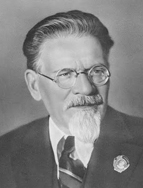
Mikhail Ivanovich Kalinin (1875–1946) – the nominal head of state of the Soviet Union from 1919 to 1946. From 1926 he was a member of the Politburo of the Communist Party of the Soviet Union, where he was one of the inner circle of party leaders around Soviet leader Joseph Stalin.
|
Archpriest Leonid Konstantinov, prior of the Nikolo-Iosafovsky Cathedral
After the war, Stalin’s daughter Svetlana Alliluyeva and Georgi Malenkov were baptised, and the one who confessed and received Holy Communion was the All-Union elder Mikhail Ivanovich Kalinin.
|
Протоиерей Леонид Константинов, настоятель Николо-Иосафовского собора [ Выпуск 11 ]
После войны приняли крещение Светлана Аллилуева, дочь Сталина, Георгий Маленков, исповедовался и принял Святое Причастие всесоюзный староста Михаил Иванович Калинин.
|
|
Another source about Kalinin: Memoirs of A. P. Artsybushev in the book “Lift up your hearts”. Archpriest Vladimir Smirnov (spiritual children about the spiritual father). M. 2004, p. 67.
|
Другой источник о Калинине: Воспоминания А. П. Арцыбушева в кн.: «Горе имеим сердца». Протоиерей Владимир Смирнов (духовные дети о духовном отце). М. 2004, С. 67.
|
Infidels
Comments • 0
|
|
|
Pol Pot and Theravada Buddhism
Pol Pot (1925-1998) tried to erase individuality as he thought that differences create conflicts. With his artificial equality, abolishing private possessions and so erasing natural selection from society he was doomed by Evolution to fail, like all other communists. Pol Pot targeted not just different religions as differences, but education, science and medicine too. Cambodia’s communism was influenced by Theravada Buddhism and its teaching to renunciation of the material world as Pol Pot with his followers organized perfectly by smashing cars and modern industrial equipment with hammers. Before Pol Pot came to power, about 95% of Cambodians called themselves Buddhists, and Buddhism was the state religion. After his regime fell in 1979, Buddhism became the state religion in 1989 again. The CIA World Factbook listed 95% of Cambodians as Theravada Buddhists in 1990, and the first census after the regime, in 1998, counted 96.4% Buddhists, 2.1% Muslims, 1.3% other and 0.2% unspecified. The claim that a few atheists overthrew and ruled 95% believers is a simplification: the Khmer Rouge won a civil war with a peasant army of about 68,000 soldiers, nearly all raised as Buddhists.
Pol Pot’s Education:
1934 – 1935 Wat Botum Vaddei Buddhist monastery in Phnom Penh
1935 – 1943 École Miche Catholic school in Phnom Penh
1943 – 1947 Collège Preah Sihanouk at Kampong Cham
1947 – 1948 Lycée Sisowath state French school in Phnom Penh
1948 – 1949 École Technique state French school in Phnom Penh
1949 – 1952 École Française de Radio-électricité technical school
King of Cambodia from 1941, Head of State from 1955 to 1970, who resigned in 1976 Prince Norodom Sihanouk said:
“Pol Pot does not believe in God,” Sihnaouk had said “but he thinks that heaven, destiny, wants him to guide Cambodia in the way he thinks it the best for Cambodia, that is to say, the worst. Pol Pot is mad, you know, like Hitler.”
“Whiskey Oscar Seven Bravo...” / “WO7B” A tale of Cambodia 1993 (182 page) by O. B. Wright
In 1952, before took power, Pol Pot as a student, Saloth Sar (his real name) wrote the essay “Monarchy or Democracy?” under the pen name “Khmer Daom.” In it he praised the Buddha as a moral teacher:
“Our great master Buddha was very educated; he soon realized that his father, King Suthotana… was unjustly enriched, leaving the people to languish in ignorance, disease, famine.” (...) “The democratic regime is part of Buddhist morality, because our great master Buddha was the first to have taught it.” (...) “Only the democratic regime can safeguard the deep value of Buddhism.”
Buddhists don’t believe in God. Pol Pot called himself a communist and a revolutionary, not an atheist. Some Christians would like to mix communism (social relations between humans) with atheism (humans relations with god).
About 600.000 people have been killed in Cambodia by massive US bombing from 1965 till 1973. The US has dropped 2,756,941 tons of bombs – more than all the bombs dropped by the Allies during World War II. Because of Pol Pot died about 750,000. So when someone say, that during Pol Pot’s regime died about 1.5 million people, it would be nice, that they would give some credit to Christian US too.
Infidels
Comments • 0
|
|
|
Mao Zedong and Confucionism with Taoism
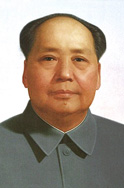
Although Mao (1893-1976) Zedong was influenced by religious ideas, he could be an atheist.
“Atheism must take the place of belief in a God.”
The Writings of Mao Zedong, 1949-1976: January 1956-December 1957 By Zedong Mao, Michael Y. M. Kau, John K. Leung (October-december 1957 / 791 page)
Pham Van Dong: How are you, Chairman Mao?
Mao Zedong: Not very well. I have had a cought for some days. It is time to go to Heaven. It seems that I am summoned to meet the Good God. How is President Ho?
"Behind the bamboo curtain: China, Vietnam, and the world beyond Asia" By Priscilla Mary Roberts. Mao Zedong and Pham Van Dong, Beijing, November 17, 1968
Although China is a socialist country, Buddhism is protected according to national policy.
The late Chairman Mao Zedong said when he received delegations from Peru in 1964 that “it is wrong to tell people to be against religion.”
He said that if China did so, “religious people would oppose us... believing in a certain religion doesn't mean people don't oppose imperialism, feudalism and bureaucratic capitalism.”
“Tibetan Buddhism: Sacred traditions have down-to-earth side”
http://english.peopledaily.com.cn/90001/90776/90882/6610660.html
The Poems of Mao Zedong : Harper & Row
It seems, Mao Zedung smoked strong weed :)
Winds flap the sail, tortoise and snake are silent, a great plan looms. A bridge will fly over this moat dug by HEAVEN and be a road from north to south. We will make a stone wall against the upper river to the west and hold back steamy clouds and rain of Wu peaks. Over tall chasms will be a calm lake, and if the GODDESS of these mountains is not dead she will marvel at the changed world. June 1956
The GODS on the death of his wife Yang Kai-hui I lost my proud poplar and you your willow As poplar and willow they soar straight up into the ninth heaven and ask the prisoner of the moon, Wu Kang' what is there. He offers them wine from the cassia tree. The lonely lady on the moon, Chang O, spreads her vast sleeves and dances for these good SOULS in the unending sky. Down on earth a sudden report of the tiger's defeat. Tears fly down from a great upturned bowl of rain. May 11, 1957
Saying Good-bye to the GOD of Disease (2) Thousands of willow branches in a spring wind. Six hundred million of China, land of the GODS, and exemplary like the emperors Shun and Yao. A scarlet rain of peach blossoms turned into waves and emerald mountains into bridges. Summits touch the sky. We dig with silver shovels and iron arms shake the earth and the Three Rivers. GOD of plagues, where are you going? We burn paper boats and bright candles to light his way to HEAVEN. July I, 1958
Saying Good-bye to the GOD of Disease (1) Mauve waters and green mountains are nothing when the great ancient doctor Hua To could not defeat a tiny worm. A thousand villages collapsed, were choked with weeds, men were lost arrows. GHOSTS sang in the doorway of a few desolate houses. Yet now in a day we leap around the earth or explore a thousand Milky Ways. And if the cowherd who lives on a star asks about the GOD of plagues, tell him, happy or sad, the GOD is gone, washed away in the waters. July 1, 1958
Taoism and Mao Zedong: http://taoism21cen.com/Englishchat/maoandtaoism.html
The Little Red Book
Apparently Mao believed in Buddhahood.
"Make trouble, fail, make trouble again, fail again . . . till their doom; that is the logic of the imperialists and all reactionaries the world over in dealing with the people's cause, and they will never go against this logic. This is a Marxist law. When we say "imperialism is ferocious", we mean that its nature will never change, that the imperialists will never lay down their butcher knives, that they will never become Buddhas, till their doom."
"Cast Away Illusions, Prepare for Struggle" (August 14, 1949), Selected Works, Vol. IV, p. 428.
Mao quoted Lao Tzu.
""Exchange information." This means that members of a Party committee should keep each other informed and exchange views on matters that have come to their attention. This is of great importance in achieving a common language. Some fail to do so and, like the people described by Lao Tzu, "do not visit each other all their lives, though the crowing of their cocks and the barking of their dogs are within hearing of each other". The result is that they lack a common language."
"Methods of Work of Party Committees" (March 13, 1949), Selected Works, Vol. IV, p. 378.
Mao said that a man in China is usually subjected to a religious authority and is one of the thick ropes binding the Chinese people together.
"A man in China is usually subjected to the domination of three systems of authority [political authority, clan authority and religious authority]. ...As for women, in addition to being dominated by these three systems of authority, they are also dominated by the men (the authority of the husband). These four authorities — political, clan, religious and masculine — are the embodiment of the whole feudal-patriarchal ideology and system, and are the four thick ropes binding the Chinese people, particularly the peasants."
"Report on an Investigation of the Peasant Movement in Hunan" (March 1927), Selected Works, Vol. I, pp. 44-46.*
Infidels
Comments • 0
|
|
|
Fidel Castro and Roman Catholic Church
 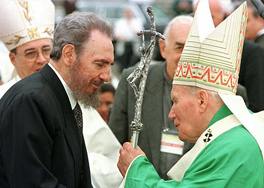
And yet the letters suggest that Castro was a man of unusual spiritual depth -- and a fervent believer in God. Addressing the father of a fallen comrade, he writes: “I will not speak of him as if he were absent, he has not been and he will never be. These are not mere words of consolation. Only those of us who feel it truly and permanently in the depths of our souls can comprehend this. Physical life is ephemeral, it passes inexorably.... This truth should be taught to every human being -- that the immortal values of the spirit are above physical life. What sense does life have without these values? What then is it to live? Those who understand this and generously sacrifice their physical life for the sake of good and justice -- how can they die? God is the supreme idea of goodness and justice.”
“Letters From Prison: Castro Revealed” by Ann Louise Bardach; Sunday, February 25, 2007
http://www.washingtonpost.com/wp-dyn/content/article/2007/02/23/AR2007022301723.html
“I never saw a contradiction between the ideas that sustain me and the ideas of that symbol, of that extraordinary figure (Jesus Christ).” - Castro in 1985.
Fidel Castro in quotes (8:55AM GMT 19 Feb 2008)
http://www.telegraph.co.uk/news/worldnews/1579170/Fidel-Castro-in-quotes.html
Infidels
Comments • 0
|
|
|
Communism and Atheism
The USSR was a union not of atheist but of communist states.
Communism/Socialism is an ideology about the relationship between people (rich) and people (poor).
Atheism/Theism is an ideology about the relationship between people (all) and God.
These are different ideologies. Communism is not about believing or not believing in God, but about social equality between people and common property (Latin “communis” = common). In the Soviet Union, property was taken from the Church not because it promoted God, but because it was rich. All rich people (non-religious ones too) were considered exploiters of the working people. People saw priests (not God) as corrupt, greedy bastards who perverted religion by using it for material gain, and who did not follow Christ’s teachings to live ascetically. The union of the Russian Church and the Tsar, with their gold, prosperity and endless wars, finally pissed off the starving masses. That is why the masses rebelled against rich people, not against God. Property was expropriated from atheists and religious people equally. The union of Monarchy and Theocracy was destroyed. At that time the Church had more property than atheists, who were an absolute minority in society then. That is why the Church lost more than atheists did. In Hitler’s Germany, Mao’s China and Pol Pot’s Cambodia (Theravada Buddhists 95%, others 5%) statistically almost all (~100%) people were believers at that time. Even in Stalin’s Russia, after 20 years of atheist propaganda, 56.7% of those who answered (aged over 16) declared themselves believers in the 1937 census.
“A. L. Eliseev writes that a meeting of the Antireligious Commission of the Central Committee of the All-Union Communist Party (Bolsheviks) took place on 23 May 1929 under the chairmanship of E. Iaroslavskii. There, believers in the country were estimated at 80 percent.”
“Religion and Politics in Russia: A Reader”, edited by Marjorie Mandelstam Balzer, p. 7
Russia only reached 24% atheists at the beginning of the 21st century. For example, Lithuania’s 1923 general census shows that 100% of the population were believers. It was believers, not atheists, who did the biggest job of robbing rich (not religious) people. In Russia in 1917, the Great October Socialist (not Atheist) Revolution was carried out by believers; atheists were an absolute minority. Yes, Lenin was an atheist, but without the support of the masses, made up almost entirely of believers, it was impossible to overthrow either the Tsar’s monarchy or the Provisional Government. Because the Church’s property was nationalised, believers (especially in the West) started to proclaim that these were atheist regimes... of course, only atheists are capable of killing, robbing and taking their neighbour’s property by force... religious people never rob and burn each other’s churches. Christianity has vast experience of killing and robbing not only other religions or unbelievers, but its own denominations too. You don’t need to be an atheist to do that. In the USSR the Church was separated from the state, as in the USA, many EU and other civilised countries of the world. Does that mean that the USA and those countries are atheist regimes? Communists did not destroy religion. In Soviet times the Church kept functioning also because the KGB successfully used it to spy on people through confession. Communists preserved it by building their ideology on religious-authoritarian foundations of worship. There are more believers in Eastern-Communist countries than in Western-Capitalist Europe. Under Communism you can believe in whatever you want, as long as you glorify communism and do not doubt it. The share of atheists/agnostics (lowest estimates):
Top 50 Countries With Highest Proportion of Atheists / Agnostics (Zuckerman, 2005) • adherents.com
Japan 64%
Sweden 46%
Denmark 43%
France 43%
Belgium 42%
Germany 41%
Netherlands 39%
Britain 31%
Russia 24%
“In 1967 Albania was proclaimed the world’s first atheist state. After the ban was lifted at the end of 1990, however, the population was found to be, as before World War II, approximately 70 percent Muslim and 30 percent Christian”
“Conflict in the former Yugoslavia: An Encyclopedia” by John B. Allcock, Marko Milivojević and John Joseph Horton
About China: “But probably 90 percent of the population occasionally resorted to Buddhist rites or temples and 99 percent were affected by Buddhist contributions to Chinese thought and behaviour.”
“The Practice of Chinese Buddhism, 1900–1950” by Holmes Welch
Many of the world’s Communist states officially declared themselves secular. However, statistics show that most of them remained, and still are, fairly religious. If communism was a movement to advance atheism, it sure didn’t have much of an effect. Religious statistics of “historical Communist states” from the CIA’s “The World Factbook” (2010):
| Country |
Indigenous
beliefs |
Christians |
Muslims |
Buddhists |
No religion |
Other or
Not stated |
| Afghanistan |
|
|
99% |
|
|
1% |
| Albania |
|
30% |
70% |
|
|
|
| Angola (1998) |
47% |
53% |
|
|
|
|
| Azerbaijan (1995) |
|
4.8% |
93.4% |
|
|
1.8% |
| Benin (2002) |
17.3% |
42.8% |
24.4% |
|
|
15.5% |
| Bosnia and Herzegovina |
|
46% |
40% |
|
|
14% |
| Bulgaria (2001) |
|
83.8% |
12.2% |
|
|
4% |
| Cambodia (1998) |
|
|
2.1% |
96.4% |
|
1.5% |
| Congo (Brazzaville) |
48% |
50% |
2% |
|
|
|
| Croatia (2001) |
|
92.6% |
1.3% |
|
5.2% |
0.9% |
| Czech Republic (2001) |
|
28.9% |
|
|
59% |
12.1% |
| Estonia (2000) |
|
27.8% |
|
|
40.2% |
32% |
| Ethiopia (2007) |
2.6% |
62.8% |
33.9% |
|
|
0.7% |
| Georgia (2002) |
|
88.6% |
9.9% |
|
0.7% |
0.8% |
| Grenada |
|
100% |
|
|
|
|
| Hungary (2001) |
|
74.4% |
|
|
14.5% |
11.1% |
| Laos (2005) |
31.5% |
1.5% |
|
67% |
|
|
| Lithuania (2001) |
|
85% |
|
|
9.5% |
5.5% |
| Macedonia (2002) |
|
65.1% |
33.3% |
|
|
1.6% |
| Mozambique (2007) |
|
56.1% |
17.9% |
|
18.7% |
7.2% |
| Poland (2002) |
|
91.4% |
|
|
|
8.6% |
| Romania (2002) |
|
99% |
|
|
0.1% |
0.9% |
| Serbia (2002) |
|
91.6% |
3.2% |
|
|
5.2% |
| Slovakia (2001) |
|
83.8% |
|
|
13% |
3.2% |
| Slovenia (2002) |
|
61% |
2.4% |
|
10.1% |
26.5% |
| Tajikistan (2003) |
|
|
90% |
|
|
10% |
| Turkmenistan |
|
9% |
89% |
|
|
2% |
| Uzbekistan |
|
9% |
88% |
|
|
3% |
| Vietnam (1999) |
80.8% |
7.2% |
0.1% |
9.3% |
|
2.6% |
Afghanistan: Sunni Muslim 80%, Shia Muslim 19%, other 1%
Albania: Muslim 70%, Albanian Orthodox 20%, Roman Catholic 10%
Angola: indigenous beliefs 47%, Roman Catholic 38%, Protestant 15% (1998 est.)
Azerbaijan: Muslim 93.4%, Russian Orthodox 2.5%, Armenian Orthodox 2.3%, other 1.8% (1995 est.)
Benin: Christian 42.8% (Catholic 27.1%, Celestial 5%, Methodist 3.2%, other Protestant 2.2%, other 5.3%), Muslim 24.4%, Vodoun 17.3%, other 15.5% (2002 census)
Bosnia and Herzegovina: Muslim 40%, Orthodox 31%, Roman Catholic 15%, other 14%
Bulgaria: Bulgarian Orthodox 82.6%, Muslim 12.2%, other Christian 1.2%, other 4% (2001 census)
Cambodia: Buddhist (official) 96.4%, Muslim 2.1%, other 1.3%, unspecified 0.2% (1998 census)
Congo (Brazzaville): Christian 50%, animist 48%, Muslim 2%
Croatia: Roman Catholic 87.8%, Orthodox 4.4%, other Christian 0.4%, Muslim 1.3%, other and unspecified 0.9%, none 5.2% (2001 census)
Czech Republic: Roman Catholic 26.8%, Protestant 2.1%, other 3.3%, unspecified 8.8%, unaffiliated 59% (2001 census)
Estonia: Evangelical Lutheran 13.6%, Orthodox 12.8%, other Christian (including Methodist, Seventh-Day Adventist, Roman Catholic, Pentecostal) 1.4%, unaffiliated 34.1%, other and unspecified 32%, none 6.1% (2000 census)
Ethiopia: Orthodox 43.5%, Muslim 33.9%, Protestant 18.6%, traditional 2.6%, Catholic 0.7%, other 0.7% (2007 Census)
Georgia: Orthodox Christian (official) 83.9%, Muslim 9.9%, Armenian-Gregorian 3.9%, Catholic 0.8%, other 0.8%, none 0.7% (2002 census)
Grenada: Roman Catholic 53%, Anglican 13.8%, other Protestant 33.2%
Hungary: Roman Catholic 51.9%, Calvinist 15.9%, Lutheran 3%, Greek Catholic 2.6%, other Christian 1%, other or unspecified 11.1%, unaffiliated 14.5% (2001 census)
Laos: Buddhist 67%, Christian 1.5%, other and unspecified 31.5% (2005 census)
Lithuania: Roman Catholic 79%, Russian Orthodox 4.1%, Protestant (including Lutheran and Evangelical Christian Baptist) 1.9%, other or unspecified 5.5%, none 9.5% (2001 census)
Macedonia: Macedonian Orthodox 64.7%, Muslim 33.3%, other Christian 0.37%, other and unspecified 1.63% (2002 census)
Mozambique: Catholic 28.4%, Muslim 17.9%, Zionist Christian 15.5%, Evangelical Pentecostal 10.9%, Anglican 1.3%, other 7.2%, none 18.7% (2007 census)
Poland: Roman Catholic 89.8% (about 75% practicing), Eastern Orthodox 1.3%, Protestant 0.3%, other 0.3%, unspecified 8.3% (2002)
Romania: Eastern Orthodox (including all sub-denominations) 86.8%, Protestant (various denominations including Reformate and Pentecostal) 7.5%, Roman Catholic 4.7%, other (mostly Muslim) and unspecified 0.9%, none 0.1% (2002 census)
Serbia: Serbian Orthodox 85%, Catholic 5.5%, Protestant 1.1%, Muslim 3.2%, unspecified 2.6%, other, unknown, or atheist 2.6% (2002 census)
Slovakia: Roman Catholic 68.9%, Protestant 10.8%, Greek Catholic 4.1%, other or unspecified 3.2%, none 13% (2001 census)
Slovenia: Catholic 57.8%, Muslim 2.4%, Orthodox 2.3%, other Christian 0.9%, unaffiliated 3.5%, other or unspecified 23%, none 10.1% (2002 census)
Tajikistan: Sunni Muslim 85%, Shia Muslim 5%, other 10% (2003 est.)
Turkmenistan: Muslim 89%, Eastern Orthodox 9%, unknown 2%
Uzbekistan: Muslim 88% (mostly Sunni), Eastern Orthodox 9%, other 3%
Vietnam: Buddhist 9.3%, Catholic 6.7%, Hoa Hao 1.5%, Cao Dai 1.1%, Protestant 0.5%, Muslim 0.1%, none 80.8% (1999 census)
Communism is not about God
 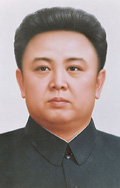
SomeMuslim fought against the Christian religion, therefore he was an atheist?
Some Protestant fought against the Catholic religion, therefore he was an atheist?
Some Orthodox Christian fought against the Catholic religion, therefore he was an atheist?
Some Pol Pot fought against the Buddhist religion, therefore he was an atheist?
Fighting against some religion or religions does not yet mean that a person is an atheist – you can be religious too. What matters is what you fight for and believe in. You can find many comments among Christians that the Church and God have nothing in common. That the Church is corrupt, perverted and seeks only money and power. That there is no need for organised religion. That God must be a private matter. The same ideas could have been in the heads of revolutionaries. This is not the first and not the last time that believers, Christians included, kill each other and destroy each other’s houses of prayer. Some people believe in a personalised-modified version of religion and God and fight against other religions or their own organised religion. Stalin murdered almost the entire Soviet military elite before the Second World War, i.e. he killed communists like flies. Does this mean that he was an anti-Soviet anti-Communist? No. He saw it as a cleansing-purification. Killing someone was not a big problem for Stalin... he handed out tickets to Paradise to everyone with a light hand. As, according to a chronicler, the papal legate Arnaud-Amaury once said: “Kill them! For the Lord knows those who are his.” Christians slaughtered each other in thousands throughout history, believing they were right and good Christians. Does that make them non-Christians? Even God slaughtered his own people in the Bible.
Pol Pot fought against organised Buddhism, and his regime tried to suppress individuality and wipe out all differences between people. He was inspired by the same Buddhism. Pol Pot’s actions were irrational, illogical and stupid. He exterminated educated people, doctors and teachers – important foundations of atheism. Even where religion was weak, there was never mass killing in the name of atheism. You will not find a flag or a poster saying “Atheism with us”, or calls for atheists to unite to kill theists. Of course, not all atheists are good and not all believers are bad. So believers should not put all the blame for Pol Pot’s behaviour and ideas on atheists, and should look for clearer evidence than “Communism = Atheism” or “If you fight against some religious denomination, you are an atheist”. Believers often blame atheists for what they did themselves.
Communism – unscientific, illogical, anti-Evolutionary
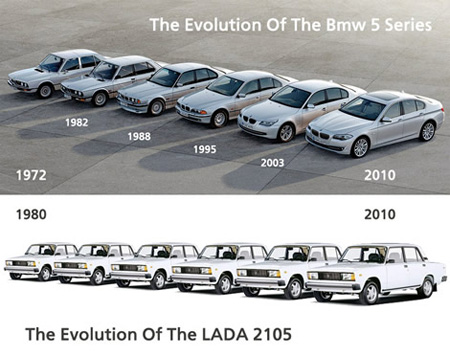
Communism contradicts Evolution. Artificial equalisation and common property remove natural selection and competition from society – the motive to try to be better than others. A person’s needs are always greater than his possibilities, and this makes people dissatisfied with what they have and pushes them forward. Limiting the possibilities to satisfy one’s needs by setting an upper limit also limits the enthusiasm to reach for something higher – there is no point reaching for the unreachable. Governments should liberalise and allow everything, as long as someone’s actions and the benefit gained are not smaller than the damage done to himself, to others and to the environment while seeking that benefit. Everything that satisfies and does not involve others in the process against their will should be moral and allowed.
Why Communism collapsed
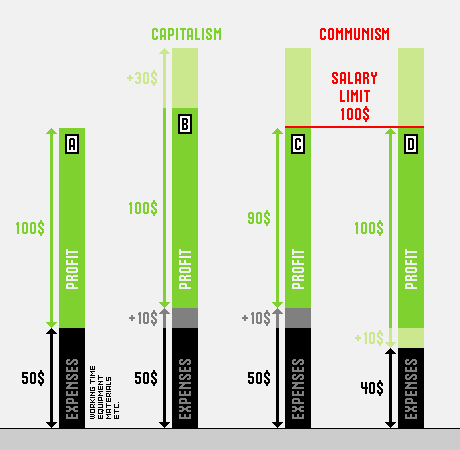
People always try to find ways to gain more profit with the smallest expenses. Under Capitalism there is almost no upper limit to how much profit a person can make – this can cause problems in society too. Under Communism, to make everyone equal, an upper limit on profit was set, and the salary paid by the government was usually the only source of profit for the majority. And no matter how much or how well you worked, you got about the same salary as others, perhaps with a worthless medal and a document saying that you were a “True Communist”.
[B] When a Capitalist worker realises that, by buying a shovel for $10, he will earn +$30, he goes for the innovation.
[C] When a Communist worker realises that, by buying a shovel for $10, he will earn +$0... because the limit is $100... The government takes everything above the limit.
[D] A Communist worker will increase his profit by cutting his expenses. Which expenses can he cut? Working time and the quality of materials. He will work less and save time (say, worth $5), keep digging with his hands, without buying a shovel, and steal something from work (worth $5). That is how he will increase his profit. Things will become easier and brighter for him personally, but the country will gain nothing.
The “rules of Communism” contradicted these “survival rules” of reality, which were formed by millions of years of evolution:
A. Individual needs have priority over social needs.
B. Output/reward must be greater than input/work, otherwise you will lose energy and die.
Rule B follows from the law of conservation of energy. All living things and structures power themselves from the energy difference between input and output; there are no exceptions. Life forms with better energy efficiency have a better chance of survival. That is why trying to work less for a lower salary is a natural response. So people started to minimise their work in order not to waste energy. The economy lost momentum, resources became scarce, and rules A and B became more and more important. The fight “Reality vs. Communism” ended 1:0.
Humans have a natural tendency to work better and with more enthusiasm for a bigger reward than for a smaller one. If the government or company owners (under communism or capitalism) rip people off by taking too large a share of their reward for the work done (usually their salary) for themselves, then, in order to survive, people will switch more and more to “resource-saving” mode, and creativity and economic growth will slow down.
Extreme inequality is as bad as extreme equality
There is a very good saying that... a man needs very little for complete happiness, but it is important that others around him have even less. People measure their wealth by comparing it with the wealth of others. That is why people in poor countries, where everyone around them is poor, can be even happier than people in rich countries, where inequality shines from everywhere. It is not only extreme inequality that is bad, like slavery, where a minority swims in luxury and the majority struggles in poverty. Communist countries went to the extreme in the other direction by making everyone too equal. People lost interest in competition, and noble slogans were not enough to motivate them, even though they hung on every corner. Under communism people were quite happy with the little they had, because everyone around them had almost the same amount of wealth and the same limited possibilities to buy anything. Of course, senior officials in the USSR had more privileges and bigger salaries, but not as big as those of private company bosses in the West. There were almost no millionaires in the USSR with whom ordinary people could compare themselves and see how poor they were. People had less motivation to strive, because striving was not rewarded as much as in the West. There was no pure communism, but there was still too much equality in society (which is as bad as too big a gap in wealth). It slowed down economic evolution and productivity. People weren’t rich, but happy, because according to propaganda life in the West was even worse:
The same years, but different “weather” (industrial crisis in all capitalist countries).
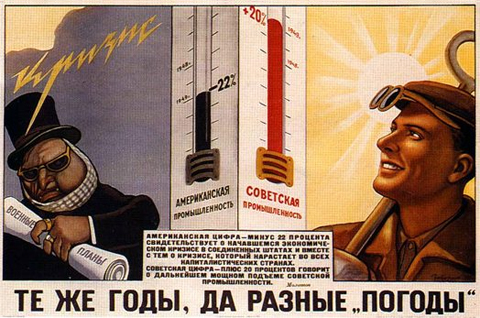
Who gets the national income? In the USSR – the working people!
In capitalist countries – the lion’s share goes to the exploiters.
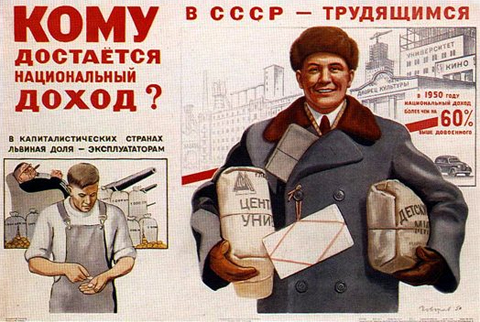
The road of talent... (in the countries of capitalism) – Make way for talents! (in the country of socialism)
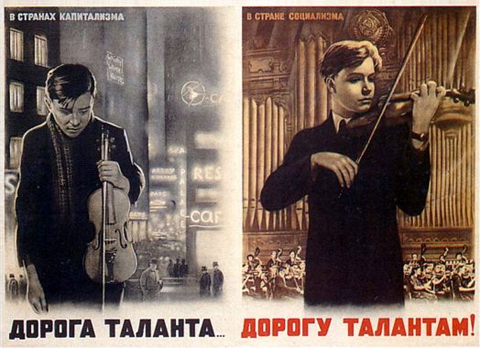
Not working and stealing from the government was the national sport of the USSR. Capitalism leans more towards innovation and ways to make more wealth and money, while Communism... towards how not to work and to steal from the government, since for many people it was the only way to make their lives better. Of course, the Communist regime paid good workers a little more, but it was not enough motivation to make them think about how to create something efficient and innovative, as under Capitalism. That is why Soviet cars and other goods in 1980 looked as if they had been made in 1960. People did not understand why the situation was so bad, and day by day their desire to stay together in such a “union of losers” grew weaker and weaker, until people (the material that held the country together) broke apart and everyone scattered in different directions.
It seems that the best economies are based on a mix of Capitalism (which represents the individualism and competition rules needed for a better chance of survival) and Socialism (which represents the protection and safety rules needed for a better chance of survival).
Constitutions of the RSFSR and the USSR (1918–1977) • “Myths about communism & atheism”
The constitutions of the RSFSR (Russian Soviet Federative Socialist Republic) and the USSR (Union of Soviet Socialist Republics) said nothing about eliminating religion. They did favour atheism, though: in 1918 clergy lost the vote together with merchants and employers (Article 65), and from 1936 believers could only worship, while atheists could also spread propaganda.
|
Constitution of the RSFSR, 1918 (“Lenin’s”),
Part 2 “General Provisions of the Constitution of the RSFSR”, Chapter 5, Article 13
|
Конституция РСФСР 1918 («Ленинская»),
Раздел 2 «Общие положения конституции РСФСР», глава 5, статья 13
|
|
“For the purpose of securing to the workers real freedom of conscience, the church is to be separated from the state and the school from the church, and the right of religious and anti-religous propaganda is accorded to every citizen.”
|
«В целях обеспечения за трудящимися действительной свободы совести церковь отделяется от государства и школа от церкви, а свобода религиозной и антирелигиозной пропаганды признается за всеми гражданами.»
|
|
Constitution of the USSR, 1936 (“Stalin’s”),
Chapter 10 “Fundamental Rights and Duties of Citizens”, Article 124
|
Конституция СССР 1936 («Сталинская»),
Глава 10 «Основные права и обязанности граждан», статья 124
|
|
“In order to ensure to citizens freedom of conscience, the church in the U.S.S.R. is separated from the state, and the school from the church. Freedom of religious worship and freedom of anti-religious propaganda is recognized for all citizens.”
|
«В целях обеспечения за гражданами свободы совести церковь в СССР отделена от государства и школа от церкви. Свобода отправления религиозных культов и свобода антирелигиозной пропаганды признаются за всеми гражданами.»
|
|
Constitution of the USSR, 1977 (“Brezhnev’s”),
Chapter 6 “Citizenship of the USSR. Equality of Citizens’ Rights”, Article 34
|
Конституция СССР 1977 («Брежневская»),
Глава 6 «Гражданство СССР. Равноправие граждан», статья 34
|
|
“Citizens of the USSR are equal before the law, without distinction of origin, social or property status, race or nationality, sex, education, language, attitude to religion, type and nature of occupation, domicile, or other status. The equal rights of citizens of the USSR are guaranteed in all fields of economic, political, social, and cultural life.”
|
«Граждане СССР равны перед законом независимо от происхождения, социального и имущественного положения, расовой и национальной принадлежности, пола, образования, языка, отношения к религии, рода и характера занятий, места жительства и других обстоятельств. Равноправие граждан СССР обеспечивается во всех областях экономической, политической, социальной и культурной жизни.»
|
|
Chapter 7 “Basic Rights, Freedoms and Duties of Citizens of the USSR”, Article 52
|
Глава 7 «Основные права, свободы и обязанности граждан СССР», статья 52
|
|
“Citizens of the USSR are guaranteed freedom of conscience, that is, the right to profess or not to profess any religion, and to conduct religious worship or atheistic propaganda. Incitement of hostility or hatred on religious grounds is prohibited. In the USSR, the church is separated from the state, and the school from the church.”
|
«Гражданам СССР гарантируется свобода совести, то есть право исповедовать любую религию или не исповедовать никакой, отправлять религиозные культы или вести атеистическую пропаганду. Возбуждение вражды и ненависти в связи с религиозными верованиями запрещается. Церковь в СССР отделена от государства и школа — от церкви.»
|
Infidels
Comments • 0
|
|
|
Religious Hell
The idea of Hell leads to violence. If Hell is eternal suffering, then there is no final point, just pointless torture. If the point is torture until the sinner understands his sins, then isn’t there a better way to make a human understand something – knowledge and education? If a child committed a mistake-sin (stealing or beating an animal), what would be better to do to make sure that he would not mistake-sin again? Sit down and talk with him, explain how the World works, explain social links, why stealing is bad, because it ruins society – his own environment, his life – how animals suffer and feel pain, explain how the effects of all actions come back to the one who acts, until he understands. Or is it better to beat your child, pull out his nails, scald his flesh with hot water and torture him? We all know that kids who experienced violence in childhood from others (like Stalin) are later more violent. The raped more often become rapists, the beaten become beaters. If you beat your child for his mistakes-sins, with every strike you install in his brain the concept that beating is an acceptable method to achieve your goals (especially when you are stronger). It makes beating OK if somebody doesn’t act how you like or want. That is why those beaten in childhood beat others in the same way later, trying to achieve their goals, just as their authority (father/mother) did in the past. The Christian idea of “education” through torture in Hell is primitive, violent and stupid. The civilised World already knows that if you want to raise a good human, you do it with education and knowledge, not with violence and torture (because people learn by copying others). Otherwise schools would be torture chambers. The main purpose and idea should be to repair broken humans in humane schools, not to finally destroy them in Hell by showing them new limits of sadism and torture. Is God so stupid and primitive that He doesn’t know a better way to teach than just through torture? Does He give priority to the fist over the intellect? Or is it just that some stupid and primitive Christians with big fists and small brains tried to apply what they had mastered best? Therefore they create for themselves an imaginary place, to enjoy in their minds the suffering of those who don’t agree with them... and in this way they compensate for their dissatisfaction in reality. If you can’t beat your opponent in reality, you can at least enjoy torturing him in your mind. The idea of Hell shows us how sick and sadistic Christianity can be at its core. Christianity still teaches the concept of Hell and still doesn’t “understand” why Hitler and Stalin (who received a religious education) were so brutal and violent. The Inquisition (torture was used to bring lost sheep back to the “right” path and to make them suffer for their sins) was the same idea of Hell brought to us by the Church. As long as the idea of Hell is alive, the idea of the Inquisition – teaching and achieving goals through torture and sadism – is alive too.
Religion always leads to Inquisition with “Disprove God’s existence!”
Every time you make a proposition and ask someone else to disprove it, you commit an Inquisition act.
In modern society, courts use the presumption of innocence – when a man is presumed innocent until his guilt is proved. Proof of guilt (the proposition) must be presented by the accuser (the proposer).
The Inquisition operated conversely. The Inquisitional court used the presumption of guilt – when someone threw a proposition-accusation, and the accused person was presumed guilty… until he proved that he was not. And the one supposed to disprove the proposition-accusation was the accused person. This made it very easy to deal with (crucify) anybody by throwing any ridiculous propositions-accusations-claims… like “he is cooperating with the devil” or “she is a witch”. And it was even easier in the past, because the accused person, who was supposed to defend himself and desperately search for evidence of his innocence, was usually imprisoned (as already guilty). Also, it is hard to find evidence for something that never existed and does not exist. What evidence does nothing have? Of course, the best evidence for nothing is... nothing. But the accusers wanted... something... to disprove their nothing. In religious discussions between theists and atheists... theists still throw the proposition that God exists and wait for atheists to disprove it – which atheists almost always try to do. Believers just rest and wait for some visible or touchable evidence that could prove their non-existent God-nothing. Therefore atheists try to replace God-nothing with something (scientific explanations of things and events). It looks as if Christians are waiting for some touchable and visible evidence for a vacuum. To this day believers cannot prove their proposition (God), so to this day they try to use Inquisition tactics (presumption of guilt) in debates. Therefore it is important always to raise the alarm when religion gains more power in society and in social law, which determine people’s lives. Because to this day... religion and its followers are no more advanced in thinking and methods than in the 16th century. The presumption of guilt method can be found very often in religious society. For example, the war in Iraq. People started a war with Iraq believing in weapons of mass destruction, without supporting these claims with strong evidence. You can see the presumption of guilt in private life, when people deal with their opponents by throwing accusations without evidence. And people don’t need evidence… all they need is just blind faith-belief and a desire to crucify somebody. If you care about a better society for yourself and your kids, try to remove religious thinking and replace it with logic and reason.
Incompetence, or not knowing how to explain some things and events, is NOT evidence of God! It is evidence of incompetence and of a person’s lack of knowledge.
Religion leads to populism and demagogy in politics and personal life.
Bible:Ps:128:4 Lo, thus shall the man be blessed who fears the LORD.
Bible:Jo:20:29 Jesus said to him, “Have you believed because you have seen me? Blessed are those who have not seen and yet believe.” (note: who believe without evidence)
Religion-belief is directly involved in spreading not just the presumption of guilt, but also the message that somehow blind belief-faith without evidence has great value – even greater than belief based on evidence. Thanks to such thinking, anyone in a religious society can throw promises and people will believe and accept them as truth without supporting evidence. There is an absolutely reversed situation in a sceptics’ society, because sceptics appeal not to belief, but to evidence. When somebody throws promises, he must prove and support his claims with evidence himself. And only after that, when the evidence is presented, can the promises be accepted. It is no surprise when an unknowing person tries to present his unknowingness as an “advantage” – he feels better when he thinks that he at least has something valuable – his unknowingness – Jesus (God-Authority) personally values that... and who cares about small humans. It is not hard to understand why in a sceptics’ society, which appeals to evidence, the presumption of innocence and objective opinion dominate more… and in a believers’ society, which appeals to propositions and belief without evidence, the presumption of guilt and a bigger risk of preconceived opinion dominate. It is very easy to crucify anybody with sometimes absolutely ridiculous claims in a religious society – it is why a believers’ society is not safe. It is why injustice, populism and demagogy prosper in a believers’ society. It is why in a believers’ society orators can win who spiel with their golden tongues and make unreal promises without clear evidence of how these promises will be realised. People value persons (for example politicians and priests) who can lie more and better without shame, who promise bigger golden mountains and Heaven for everyone. People value their leaders not just for what they have already done, but for what they promise to do in the future. And the stronger the belief (blind faith)… the more promises are overrated compared with already realised tasks. It is why in America and in other countries politicians strongly support religion – it is a wide-open gate for them to trick-fool common people, get power and control them. Science, education, knowledge and appealing to clear evidence lead us to a safer society, reduce the possibilities for liars and bullshitters to enter politics and gain power… and don’t let anyone crucify innocent people so easily by setting a blind crowd against them. It is more difficult to reach agreement or the right decision (for example, in the same family) between believers with different opinions than between persons who base their opinions on logical arguments and strong evidence.
Even if we suppose that Hitler and Stalin were not religious themselves, but just exploited the RELIGION of their people... this shows... that Hitler appealed exactly to RELIGION (Christianity) to gain full power and realise his ideas more easily, and Stalin turned to it in 1943 to rally the people in the war.
Infidels
Comments • 0
|
|
|
